
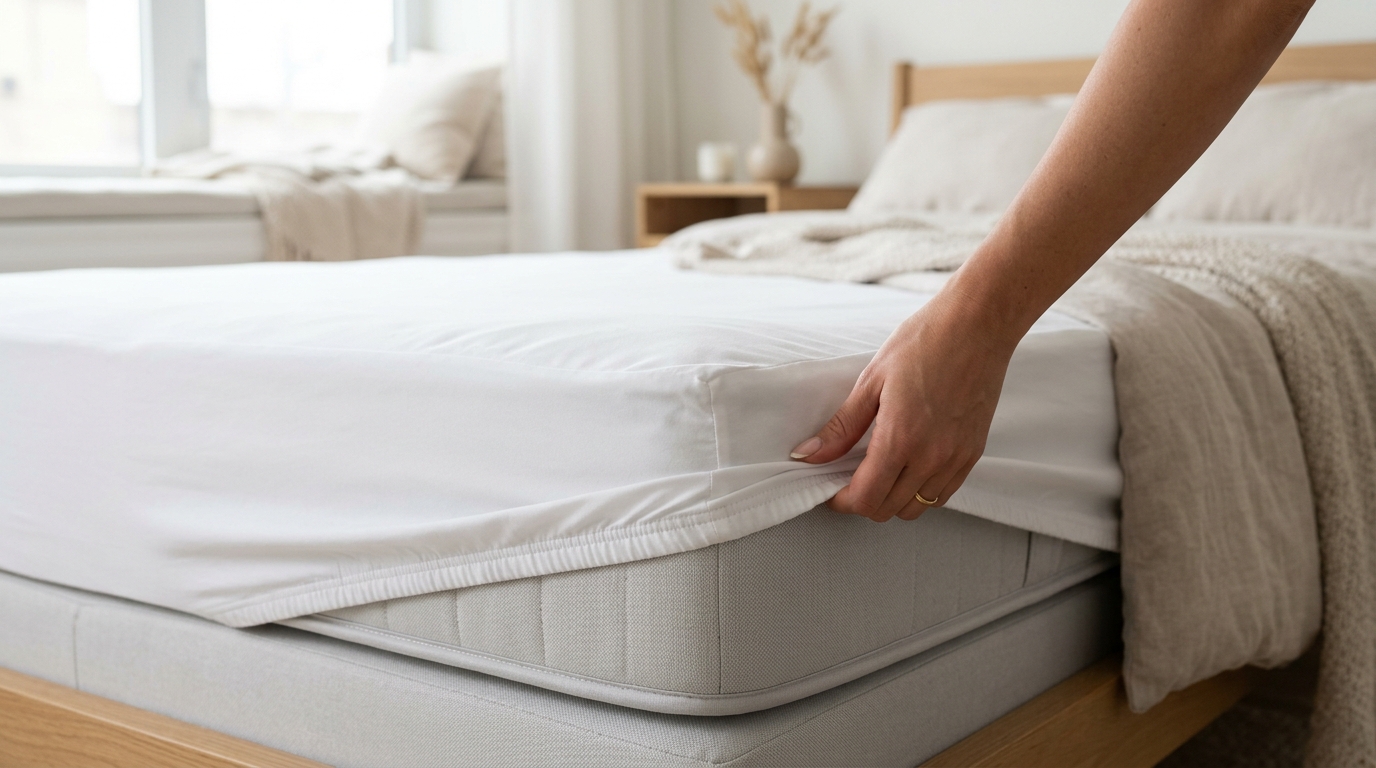
A mattress protector is a thin, washable cover that fits over your mattress, under the fitted sheet, and stops spills, sweat, stains and dust before they soak in. It is the simplest way to keep a good mattress clean for longer, and in a warm, humid city like Lagos it earns its place quickly.
This guide explains what a mattress protector is, how it differs from a mattress cover, pad or topper, how to choose the right fabric and size, and how to wash it properly. If you are ready to buy, go straight to E’sorae Home’s mattress protector range.
In short:
- A mattress protector is a removable barrier that keeps liquids, sweat and dust out of your mattress.
- It is optional for sleep quality, but it is the cheapest way to protect a mattress and its warranty.
- Look for a breathable waterproof layer, the right size and depth, and a machine-washable fabric.
What Is a Mattress Protector?
A mattress protector is a removable, washable layer that fits over the top and sides of a mattress, beneath the fitted sheet. It guards against liquids, sweat, stains, dust and allergens, and it is built for protection rather than extra cushioning. Most stay in place with elastic corners or elastic sides.
Think of it as a barrier you wash instead of a mattress you replace. A fitted sheet is the fabric you sleep on, but it does not stop liquid from reaching the mattress. A topper adds a thick comfort layer, but a protector does not change how the bed feels.
Protectors differ in three main ways: whether they are waterproof, what the top fabric is made of, and how they attach to the mattress. Those three differences drive most buying decisions.
What Is the Difference Between a Mattress Protector, Cover, Pad, Topper and Encasement?
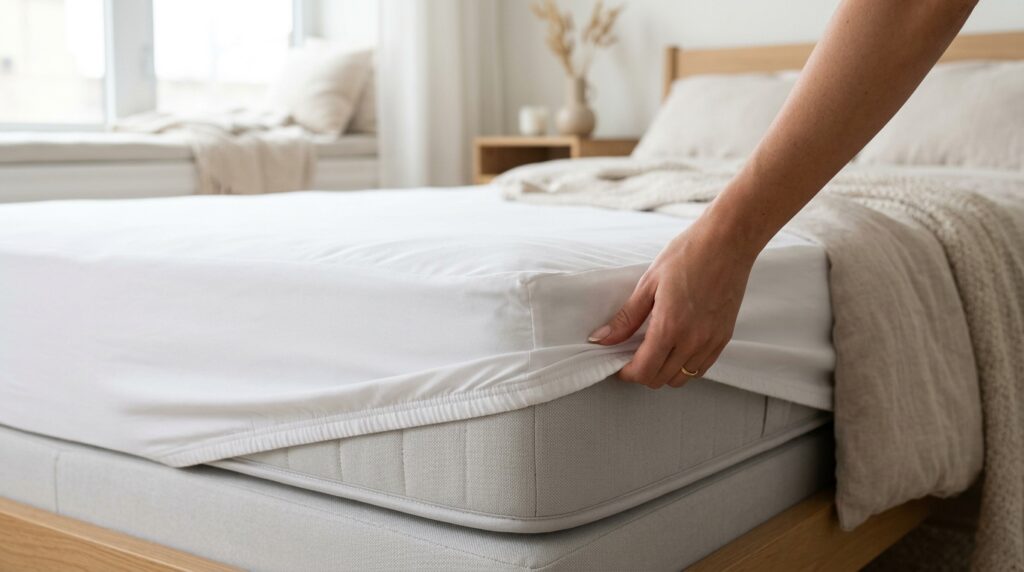
A mattress protector is a thin barrier for the top and sides of a mattress. A pad adds light cushioning, a topper adds thick comfort and changes firmness, and an encasement zips around all six sides. “Mattress cover” is used loosely for any of these, so read the product description.
| Product | Main job | What it covers |
|---|---|---|
| Mattress protector | Blocks liquids, stains, sweat and dust | Top and sides, held by elastic |
| Mattress pad | Adds light cushioning; may include a waterproof layer | Usually the top |
| Mattress topper | Adds thick comfort and changes firmness | The top |
| Mattress encasement | Seals the whole mattress, including the underside | All six sides, zipped |
| Fitted sheet | The sleeping surface you wash often | Top and sides |
The Sleep Foundation explains that a protector shields the sleep surface while an encasement surrounds the whole mattress, and that a pad gives cushioning and can also act as a barrier when it has a waterproof layer. If you want extra softness as well as protection, pair a protector with a topper such as the Memory Mattress Topper.
Why Does Every Bed Need a Mattress Protector?
Every mattress slowly absorbs sweat, body oils, skin flakes and the occasional spill, and these are very hard to clean out once they soak in. A protector stops them at the surface, so you wash a cover instead of replacing a mattress. It is optional, but it is the cheapest way to extend a mattress’s life.
It stops spills, sweat and accidents
Liquid soaks into foam and springs within seconds. Sweat and body oils also build up night after night, more so on warm, humid nights. A waterproof protector holds all of this at the surface, where one wash removes it.
It keeps the mattress more hygienic
Dead skin, body oils and dust collect in every bed. Dust mites feed on skin flakes, and their droppings are what trigger symptoms in people with a dust mite allergy. A protector keeps much of this build-up in a layer you can wash, rather than inside the mattress.
One honest limit: a fitted protector is not the same as a certified allergen-proof encasement. If a doctor has diagnosed a dust mite allergy, ask about zippered allergen-proof covers for the mattress and pillows, which the Asthma and Allergy Foundation of America recommends as a first step. For most households, a washable protector plus regular washing of bedding is a practical routine. The Sleep Foundation also notes that protectors are a good idea for people with allergies or pets.
It helps protect your mattress warranty
Stains from spills and accidents generally void mattress warranties, according to the Sleep Foundation. Read your warranty wording, and fit a protector on day one, before any accident happens.
It protects what you paid for
A good mattress is a large purchase, and a protector costs a fraction of replacing one that is stained or smells. How long a mattress lasts still depends on its build quality, how it is used and how it is cared for, but a clean surface helps.
It suits children, guests and rental use
Children have accidents, guest rooms get uneven use, and serviced apartments change hands often. A removable protector can be stripped and washed between users without touching the mattress. Businesses buying in volume can ask about E’sorae’s hospitality supply service.
Is a Mattress Protector Worth It?
For most households, yes. A mattress protector is optional for sleep quality, but it protects the mattress, helps keep it hygienic and supports warranty claims. It matters most if you have children, pets, allergies, hot nights, regular guests, or a premium mattress you want to keep in good condition.
You may not need a separate one if your mattress already has a built-in washable waterproof cover, or you already use a waterproof mattress pad. The Sleep Foundation calls a protector an optional accessory, so the decision comes down to how much you want to protect.
Who Should Use a Mattress Protector?
- Homeowners and renters who want to keep a mattress clean and resale-ready.
- Parents who need waterproof protection for children’s beds.
- Anyone with a new mattress, especially one with a stain-sensitive warranty.
- Couples and premium bedding buyers who want protection that does not rustle or run hot.
- People with allergies or pets, as one part of a wider routine (see the allergy note above).
- Hotels, guest houses and serviced apartments that need fast turnaround between guests.
How Do You Choose the Right Mattress Protector?
Choose a mattress protector by four things: the waterproof layer, the top fabric, the fit and size, and how easy it is to wash. The best option depends on whether you need full waterproofing, as for children, spills or hospitality, or lighter protection against sweat and dust.
1. The waterproof layer
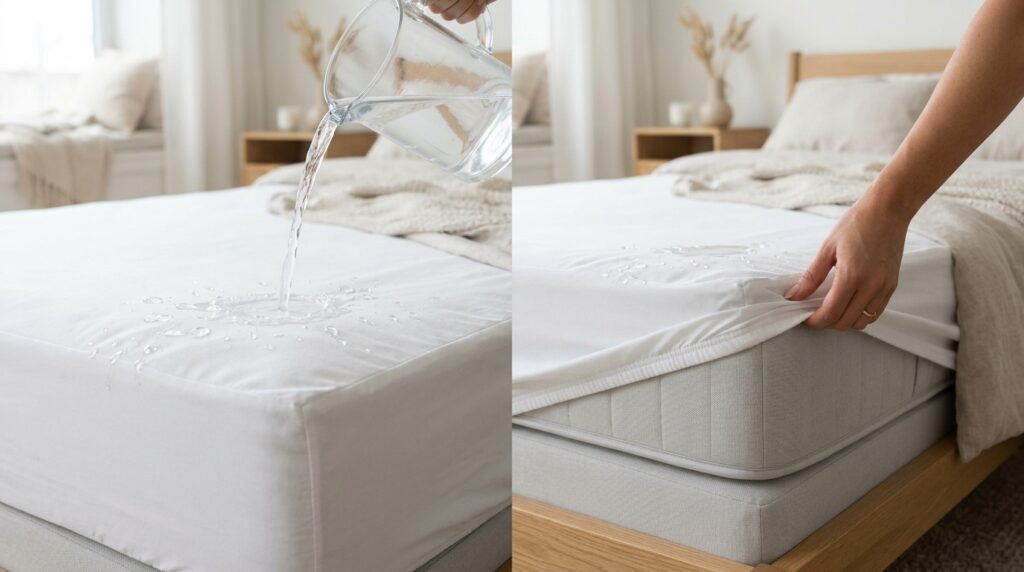
Waterproof protectors use a thin plastic-type membrane under a fabric top. TPU (thermoplastic polyurethane) is a flexible, quiet membrane used in many premium protectors, and E’sorae’s Signature protector uses one. Cheaper PVC-style coatings tend to feel stiffer and noisier.
No waterproof layer is perfectly cool. The Sleep Foundation notes that many protectors with polyurethane membranes sleep a little warm, so a breathable top fabric matters as much as the membrane.
2. The top fabric and feel
Cotton-faced protectors feel natural and absorb moisture. Polyester microfiber tops feel smooth and dry quickly. For a soft, premium feel, press the fabric between your fingers and listen for rustling, because noise is the most common complaint about cheap protectors. Always check the product page for the exact fabric.
3. The fit
A fitted mattress protector uses elastic to grip the mattress, either as a deep skirt or as elastic sides. E’sorae Signature Waterproof Mattress Protector uses deep-fit elastic for mattresses up to 40 cm deep, while the Side Elastic Mattress Protector uses stretchable elastic sides to fit different depths.
4. The care routine
A protector that cannot be machine washed defeats its purpose. Check the care label for the maximum wash temperature and whether tumble drying is allowed.
What Size Mattress Protector Do You Need?
Buy the protector that matches your mattress size and depth. E’sorae lists Full XL (4.5 x 6), Queen (5 x 6), King (6 x 6), California King (6 x 7) and Super King (7 x 7), with sizes in feet. Measure your mattress first, because brands label sizes differently.
| Size | Dimensions (feet, as listed) | Signature Waterproof | Side Elastic |
|---|---|---|---|
| Full XL | 4.5 x 6 | No | Yes |
| Queen | 5 x 6 | Yes | Yes |
| King | 6 x 6 | Yes | Yes |
| California King | 6 x 7 | Yes | Yes |
| Super King | 7 x 7 | Yes | Yes |
To measure your mattress:
- Measure the length and width, or read the size label on the mattress.
- Measure the depth from the top surface to the bottom edge.
- Add the thickness of any topper if the protector will go over it.
- Compare the result with the protector’s stated size and fit depth. The Signature protector fits mattresses up to 40 cm deep.
- If you are between sizes or unsure, ask an advisor at an E’sorae showroom.
Do Mattress Protectors Make You Sleep Hot?
Some do. Waterproof membranes can hold more heat than plain fabric, but a thin breathable membrane and a breathable top fabric reduce the effect. In warm Nigerian weather, choose a thin, quiet, breathable protector and avoid thick, plasticky ones that trap heat and rustle.
E’sorae describes the TPU membrane in its Signature protector as breathable. If heat is your main worry, feel the fabric in a showroom before you buy.
How Do You Wash and Care for a Mattress Protector?
Wash a mattress protector in a machine at the temperature on its care label, dry it fully on a low setting, and refit it only when it is completely dry. Most problems come from heat that is too high or from putting it back damp.
- Check the label. E’sorae’s Signature protector is machine washable at 60°C, and its Side Elastic protector at 140°F (about 60°C), which E’sorae says helps remove dust mites.
- Keep the wash simple. Avoid bleach and fabric softener unless the label allows them, since they can damage waterproof layers.
- Dry gently. Tumble dry on low or air dry. High heat can damage the waterproof layer.
- Refit only when dry. A damp protector can trap moisture against the mattress.
- Set a routine. A practical routine is to wash every one to two months and straight after any accident, and more often for children, heavy sweaters and allergy-prone sleepers.
For bedding care in general, see E’sorae’s laundry care guide.
Common Mistakes When Buying a Mattress Protector
- Ordering by size name without measuring the mattress depth.
- Choosing the cheapest plasticky option, which rustles and traps heat.
- Treating a topper or a fitted sheet as a protector. Neither reliably stops liquid.
- Waiting for the first stain. By then the warranty may already be affected.
- Washing or drying on high heat, which can shorten a protector’s life.
- Forgetting the pillows, which absorb sweat and oils too.
Mattress Protectors in Nigeria: E’sorae Home Options
E’sorae Home offers three protectors in its protector range. Prices below were checked on 9 November 2026 and vary by size.
| Product | Best for | Sizes |
|---|---|---|
| Signature Waterproof Mattress Protector | Everyday premium protection on larger beds | Queen to Super King |
| Side Elastic Mattress Protector | Secure fit across the widest size range, including guest rooms | Single to Super King |
| Waterproof Pillow Protector, Set of 2 | Protecting pillows from sweat, oils and spills | Set of 2 |
Choose the Signature protector if you have a Queen or larger bed and want a soft, quiet surface with a deep-fit skirt. Choose the Side Elastic protector if you need a Single or Full XL size, or a secure stretch fit across different mattress depths. Add the pillow protector to keep your pillows fresh.
Delivery takes 2 to 13 days, or you can collect from a showroom at checkout. Hotels and businesses can enquire about bulk and business orders.
Conclusion
A mattress protector is a small, washable layer that protects a large investment. It keeps spills, sweat, stains and dust out of your mattress, supports your warranty, and makes the bed easier to keep clean, whether it is a family bed, a guest room or a serviced apartment.
Measure your mattress, pick a breathable waterproof layer, and wash it on a routine. When you are ready, see E’sorae’s mattress protectors, or pair one with a new mattress and fresh sheet sets to complete the bed.
