


You lie down exhausted, and your mind refuses to switch off. Sound familiar?
The right diffuser scents for sleep can shift a bedroom from “somewhere I collapse” to “somewhere I rest.” Scent is the only sense wired directly into the limbic system, the part of the brain that handles emotion and memory. That shortcut is why a smell can calm you before you have consciously thought about it.
This guide covers nine research-supported scents, how to use them, and the mistakes that quietly cancel out the benefit. It is written with Nigerian homes in mind: warm nights, humidity, harmattan dust, and unreliable power.
How Scent Actually Affects Sleep
Quick answer: Calming scents work by signalling safety to the nervous system. Aroma molecules travel through the olfactory bulb to the amygdala, which lowers arousal and makes it easier to fall asleep.
Most sleep advice targets behavior; screens, caffeine, bedtimes. Scent works differently. It bypasses conscious effort entirely.
Research published in 2024 traced lavender’s sedative effect through the olfactory pathway to GABA-producing neurons in the central amygdala. GABA is the brain’s main calming neurotransmitter. In plain terms: the smell reaches the brake pedal directly.
There is a second, underrated mechanism conditioning. Diffuse the same scent for ten consecutive nights and your brain begins reading it as a cue. The aroma becomes a signal that the day is over.
That conditioning effect is why consistency matters more than choosing the “perfect” oil.
What the Research Says
Aromatherapy sits in an honest middle ground. The evidence is genuinely promising, and it is not conclusive. Here is a fair summary.
- Lavender and deep sleep. A 2005 study published in Chronobiology International monitored 31 healthy sleepers. Inhaling lavender increased slow-wave sleep, the deep, restorative stage and participants reported more energy the next morning.
- Brainwave evidence. A 2021 pilot study in Scientific Reports released lavender aroma only after participants had fallen asleep, removing expectation bias. Delta activity during deep sleep rose; alpha activity linked to disturbance fell. The sample was small (nine people), so treat it as encouraging rather than settled.
- Pooled results. A 2025 meta-analysis in Holistic Nursing Practice combined 11 randomized controlled trials covering 628 adults. Lavender inhalation showed a statistically significant improvement in sleep quality. The authors noted study quality varied.
- Broader review. A separate systematic review of 20 randomized trials found 14 reported positive effects on sleep quality in adults without diagnosed insomnia.
What this means for you: diffuser oils for relaxation are a reasonable, low-risk addition to a nighttime routine. They are not a treatment for insomnia or sleep apnea. If you regularly sleep poorly for more than a month, see a doctor.
The Sleep Foundation and the American Academy of Sleep Medicine both recommend at least seven hours of sleep for adults. Scent supports that goal; it does not replace the hours.
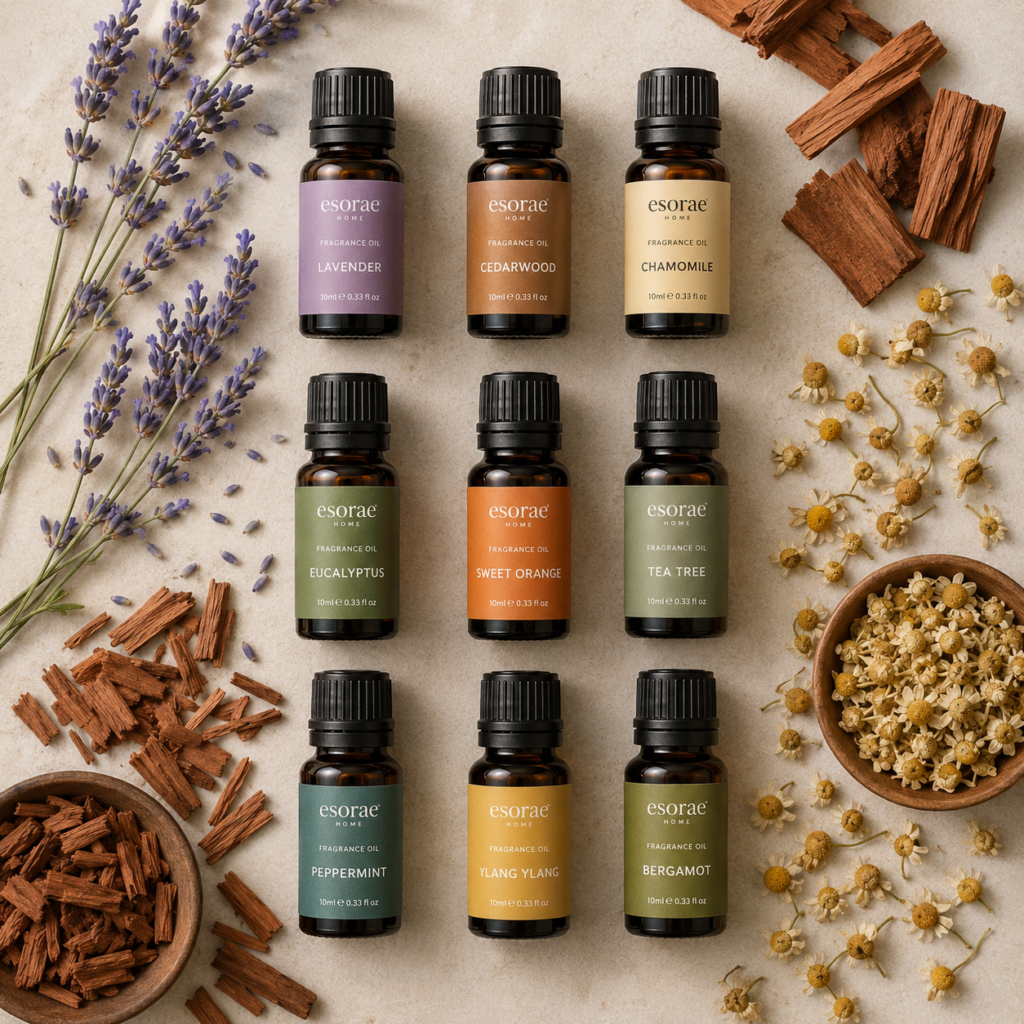
The 9 Best Diffuser Scents for Sleep
1. Lavender: The Gold Standard
Lavender is the most studied sleep aroma, and deservedly so. Its active compounds, linalool and linalyl acetate, drive the calming response.
Look for Lavandula angustifolia (true or English lavender). Lavandin, a cheaper hybrid, smells sharper and contains more camphor, which is stimulating rather than sedating.
Best for: almost everyone, especially first-timers and light sleepers.
2. Roman Chamomile: For Racing Thoughts
Softer and sweeter than lavender, with a faint apple-like note. Roman chamomile suits people whose problem is mental chatter rather than physical restlessness.
It is gentle enough for households with older children.
3. Bergamot: Citrus That Calms
Most citrus oils energise. Bergamot is the exception, thanks to a different chemical profile that lowers perceived stress.
Expert tip: because it is diffused rather than applied to skin, bergamot’s photosensitivity warning does not apply here.
4. Cedarwood: Grounding and Affordable
Cedarwood contains cedrol, a compound linked to sedative effects. It smells warm and woody — closer to furniture polish than perfume, in the best way.
It is one of the cheapest sleep oils available, which makes it ideal for nightly use.
5. Sandalwood: Quietly Luxurious
Rich, creamy and long-lasting. Its active compound, santalol, is associated with relaxation and reduced wakefulness.
Genuine sandalwood is expensive due to sustainability restrictions. Check sourcing before paying premium prices.
6. Vetiver: Deeply Sedating
Vetiver (known as khus-khus in parts of West Africa) is thick, earthy and smoky. Many people find it the most physically sedating oil of all.
Use one drop. It overwhelms a small room quickly.
7. Ylang-Ylang: Floral and Slowing
Ylang-ylang has been associated with reduced heart rate and blood pressure in small studies. The scent is intensely floral and divides opinion.
Best for: sleepers who feel wired and tense at bedtime.
8. Sweet Marjoram: The Underrated One
Warm, herbaceous and comforting. Sweet marjoram is a favourite among aromatherapists but rarely appears in commercial sleep blends.
Pairs beautifully with lavender.
9. Frankincense: For Slow, Deep Breathing
Frankincense encourages slower breathing, which lowers heart rate naturally. Resinous and slightly sweet, it suits people who like meditative, incense-like bedroom diffuser scents.
Three Blend Recipes Worth Trying
Measurements are for a standard 100ml ultrasonic diffuser filled to the line.
| Blend Name | Recipe | Why It Works |
|---|---|---|
| The Classic | 3 drops lavender + 2 drops cedarwood | Balanced, safe, ideal for beginners |
| Deep Reset | 2 drops vetiver + 3 drops lavender + 1 drop frankincense | Heavier and grounding for genuinely restless nights |
| Sunday Night Calm | 3 drops bergamot + 2 drops Roman chamomile | Eases the “tomorrow is Monday” tension |
Start with fewer drops than you think you need. Stronger is not better, an overpowering room can trigger headaches and actually delay sleep onset.
Scents to Avoid Before Bed
Several popular oils do the opposite of what you want after dark.
- Peppermint: increases alertness; excellent at 7am, counterproductive at 10pm
- Eucalyptus: sharp and stimulating, though useful during a cold
- Lemon, grapefruit, sweet orange: bright citrus oils that lift mood and energy
- Rosemary: associated with improved concentration, not relaxation
- Cinnamon and clove: warming but intense; can irritate airways in a closed room
Save these for your living room, kitchen or workspace.
What to Check Before You Buy
- Timer options: a 1-hour or 2-hour setting is essential for bedtime use
- Noise level: anything audible from the bed defeats the purpose
- Auto shut-off: protects the unit when water runs out
- Tank capacity: match it to your room size, not the price tag
- Light control: the ability to dim or disable LEDs matters, since light suppresses melatonin
Nigerian buyers should weigh one extra factor: power reliability. If your supply is inconsistent, a reed diffuser or a rechargeable USB unit removes the frustration entirely.
Building a Sleep-Friendly Bedroom
Fragrance works best as one layer among several. The Sleep Foundation recommends a bedroom temperature around 18.3°C (65°F), with most adults comfortable between roughly 15.6°C and 19.4°C.
That is a challenge in Nigeria. The World Health Organization has flagged 26°C as an upper guideline for indoor temperatures, and many bedrooms sit above it on humid nights.
Practical adjustments that stack well with sleep aromatherapy:
- Run AC or a fan for 30 minutes before bed to pre-cool the room
- Switch to breathable cotton or linen bedding rather than polyester
- Use blackout curtains, light exposure suppresses melatonin
- Keep phones face-down and out of arm’s reach
- Add a low-wattage warm lamp instead of overhead lighting after 9pm
- Reduce clutter; a calm bedroom environment is visual as well as olfactory
Scent, temperature, darkness and quiet compound each other. Fix two and you will notice a difference. Fix all four and the change is significant.
FAQs
Which diffuser scent is best for sleep?
Lavender is the best-supported diffuser scent for sleep. Multiple randomised trials link lavender inhalation to improved sleep quality and increased deep sleep. Cedarwood and Roman chamomile are strong alternatives if you dislike the smell.
Can I leave a diffuser on all night?
It is not recommended. Run it for 30 to 60 minutes before bed, then switch it off. Continuous overnight use raises humidity, wastes oil, and offers no proven extra benefit.
How many drops of essential oil should I use?
Use 3 to 5 drops per 100ml of water. Powerful oils such as vetiver and sandalwood need only 1 to 2 drops. Start low and increase only if the scent is barely noticeable.
Do diffusers actually help you sleep?
Evidence suggests they can help. A 2025 meta-analysis of 11 trials found lavender inhalation significantly improved sleep quality in adults. Diffusers support relaxation but do not treat clinical sleep disorders.
What is the difference between essential oils and fragrance oils?
Essential oils are distilled from plants and carry therapeutic compounds. Fragrance oils are synthetic or blended scents made for aroma alone. Both smell pleasant; only essential oils have research behind their sleep effects.
Are diffuser oils safe for children?
Avoid essential oils near infants under three months. For older children, use half the normal drops in a well-ventilated room and consult a paediatrician first. Chamomile and lavender are the gentlest options.
How long before bed should I turn on my diffuser?
Turn it on 30 to 45 minutes before bedtime. This lets the scent distribute evenly and gives your nervous system time to respond before you lie down.
Which scents should I avoid at night?
Avoid peppermint, eucalyptus, rosemary, lemon and grapefruit before bed. These increase alertness and can delay sleep onset. Save them for morning or daytime use.
Can diffuser scents help with anxiety at bedtime?
Yes, several may help. Bergamot, Roman chamomile and ylang-ylang have been associated with lower perceived stress and reduced heart rate in small studies. They pair well with slow breathing exercises.
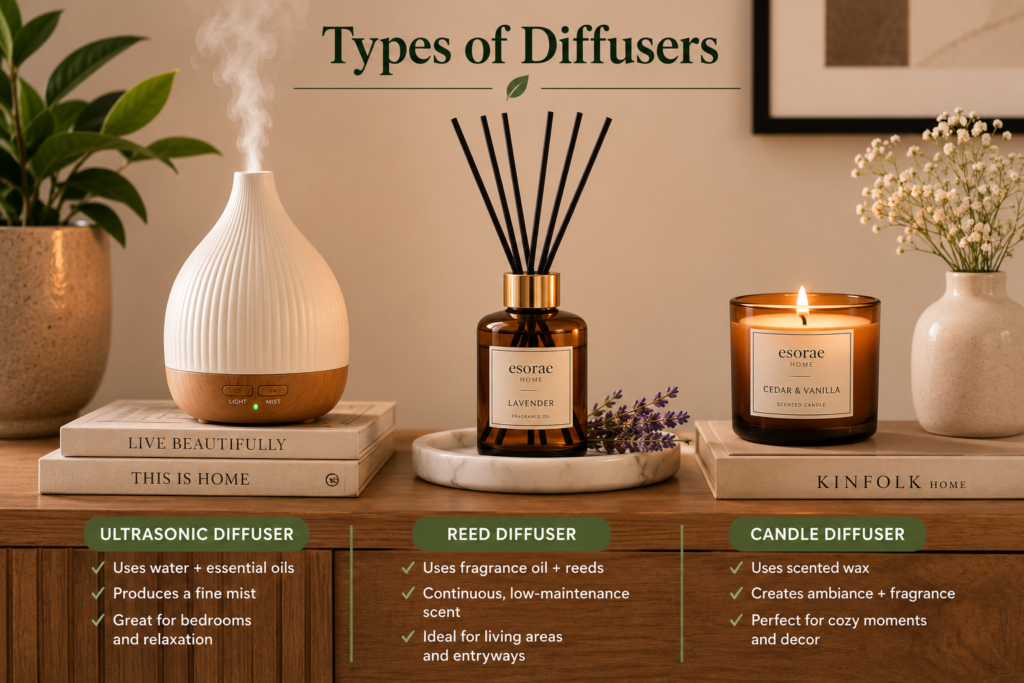
Do reed diffusers work as well as electric ones?
Reed diffusers release scent more slowly and at a fixed strength. They are ideal where power supply is unreliable, though electric diffusers give you far more control over timing and intensity.
How often should I clean my diffuser?
Empty and wipe the tank daily. Deep clean weekly using white vinegar and water, paying attention to the ultrasonic disc. Residue buildup dulls performance and creates stale odours.
Will a diffuser make my room damp?
Only if overused. A 30 to 60 minute session adds negligible moisture. Running a diffuser continuously in a humid coastal climate can encourage mould, so use the timer.
Final Thoughts
Better sleep rarely comes from one dramatic change. It comes from small, repeatable signals that tell your body the day is finished.
The best diffuser scents for sleep; lavender, cedarwood, chamomile, vetiver work because they are consistent, low-effort and pleasant enough to actually stick with. Choose one, use it nightly for two weeks, then judge honestly.
Pair it with a cooler room, dimmer light and a phone left face-down. That combination transforms an ordinary bedroom into a genuinely peaceful one.
Ready to Set the Mood?
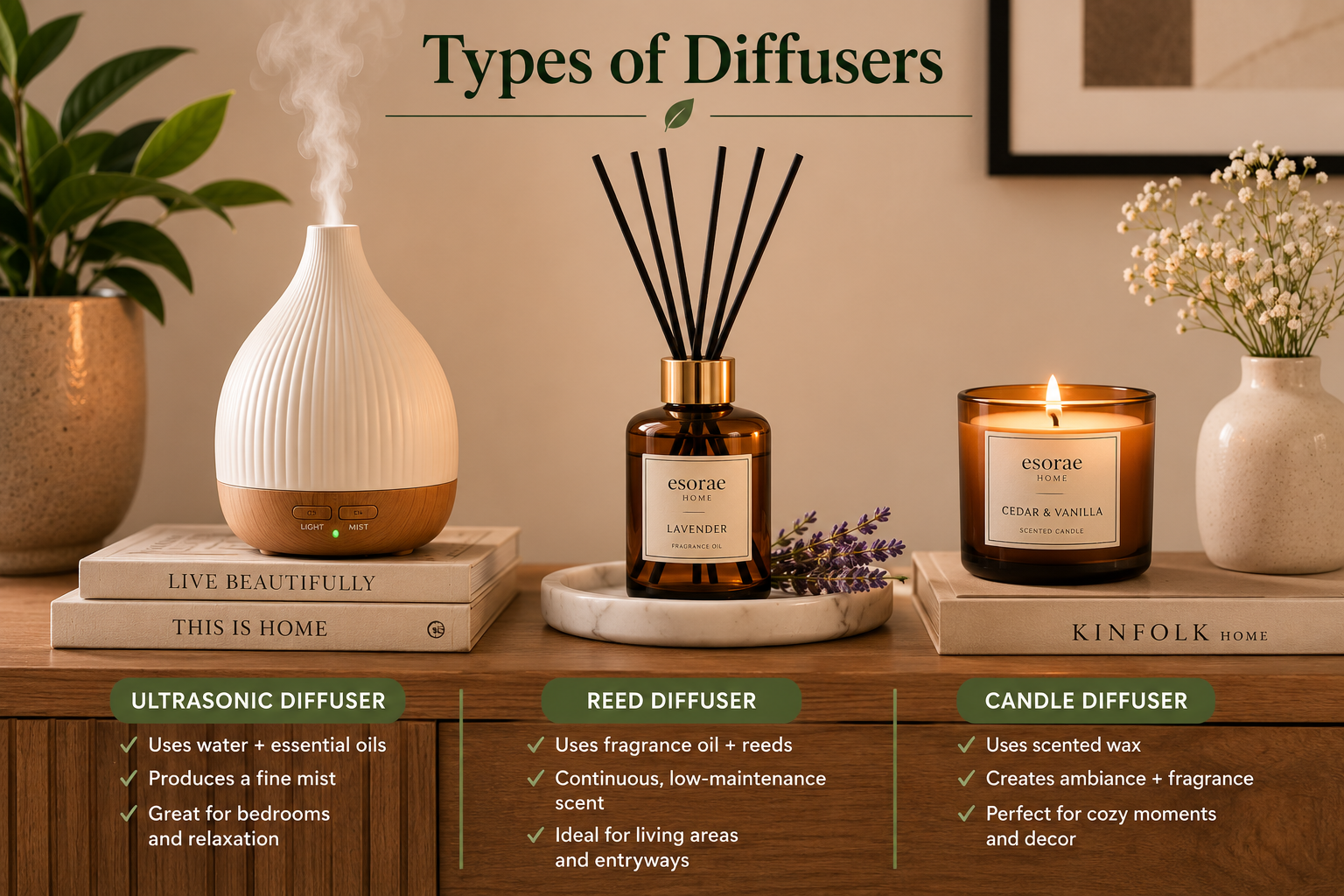
Explore the Esorae Home fragrance collection to find diffuser scents for sleep that suit your space and routine. Browse our reed diffusers for silent, power-free fragrance, our mist diffuser machines and oils for timed control, or our scented candles for a warm pre-bed ritual.
Need help choosing? Contact our team we will match a scent to your bedroom size and routine.