


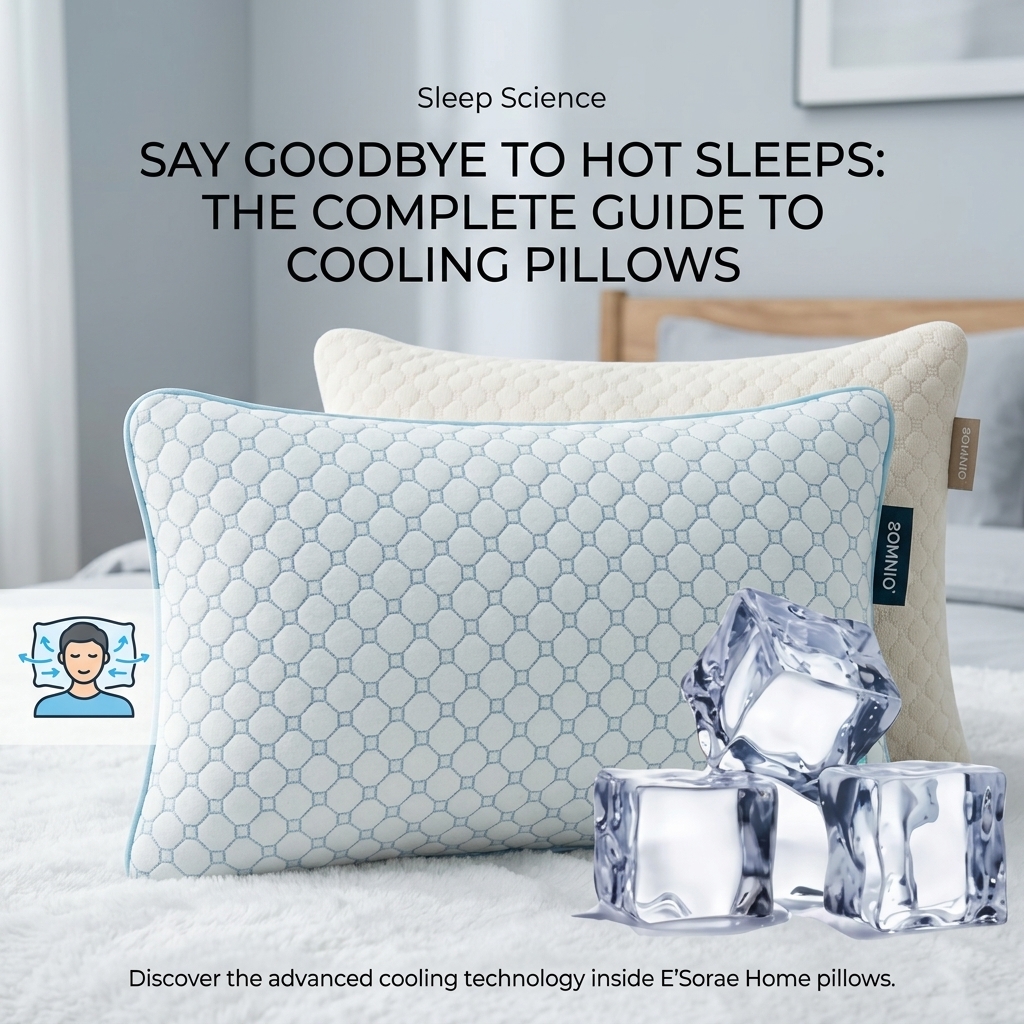
Sleeping in a warm room can become uncomfortable when your pillow holds heat around your head and neck. If you frequently turn your pillow to find a cooler side, wake up feeling sweaty, or struggle to settle comfortably at night, choosing a more breathable pillow may help.
The best cooling pillows for hot sleepers combine a comfortable sleeping surface with materials or structures designed to manage heat, encourage airflow or handle moisture. For people living in Nigeria, where warm weather and humidity can make nighttime comfort challenging, the right choice should also provide suitable head and neck support.
E’Sorae Home offers several options worth considering, including the Cool Bliss Pillow, Cooling Honeycomb Pillow and PCM Cooling Bamboo Pillow. Each has different features, so the best option depends on whether you prioritise moisture management, an airflow-focused design or temperature-regulating technology.
In this guide, you will learn how cooling pillows for hot sleepers work, what to look for before buying, and how to choose a suitable pillow for your sleeping position and comfort preferences.
What Are Cooling Pillows for Hot Sleepers?
Cooling pillows for hot sleepers are pillows designed to reduce heat build-up or create a cooler-feeling sleeping surface. They may use breathable covers, ventilated structures, gel-infused materials, moisture-managing fabrics or phase-change materials (PCM) to help manage the temperature around your head and neck.
Unlike ordinary pillows that may retain warmth, cooling pillows are designed with temperature comfort in mind. However, not every cooling pillow works in the same way, and no pillow can guarantee that you will remain cool throughout the night.
For Nigerian households, it is worth considering both the pillow’s internal construction and the fabric that touches your skin. Room ventilation, humidity, pillowcases and the rest of your bedding also affect how cool you feel.
Why Do Hot Sleepers Need a Different Pillow?
A pillow contributes to the small sleeping environment around your head and neck. When its materials retain heat or restrict airflow, you may notice warmth, dampness or discomfort, particularly if your bedroom is poorly ventilated.
The National Sleep Foundation explains that excessive warmth can interfere with comfortable sleep and that breathable bedding and a cooler sleeping environment may help. Individual comfort varies, so the most suitable solution depends on your room, bedding and personal temperature preferences.
Common reasons to consider a cooling pillows for hot sleepers include:
- Heat retention: Your current pillow becomes uncomfortably warm during the night.
- Nighttime sweating: You regularly notice moisture around your head or neck.
- Poor ventilation: Your pillow feels stuffy rather than airy.
- Frequent repositioning: You repeatedly flip your pillow to find a cooler surface.
- Support needs: You want a pillow that balances temperature comfort with suitable head and neck positioning.
If night sweats are persistent, severe or accompanied by other symptoms, consider speaking with a healthcare professional rather than assuming your pillow is the only cause.
What Are the Best Cooling Pillows for Hot Sleepers in Nigeria?
The best cooling pillows for hot sleepers depends on the features you value most. The Cool Bliss Pillow focuses on cooling and moisture-wicking comfort, the Cooling Honeycomb Pillow combines a gel honeycomb structure with a breathable cover, and the PCM Cooling Bamboo Pillow features phase-change cooling technology, an airflow core and a breathable cover.
Here is a practical comparison of three E’Sorae Home options.
| Pillow | Key features | Best suited to shoppers who prioritise |
|---|---|---|
| Cool Bliss Pillow | Cooling and moisture-wicking design, neck guard support, lightweight polyester fibre construction | A familiar cushioned pillow with a focus on moisture management and support |
| Cooling Honeycomb Pillow | Cooling gel honeycomb construction, breathable air cover, antimicrobial feature | A structured, airflow-focused design with a refreshing sleep surface |
| PCM Cooling Bamboo Pillow | PCM cooling, airflow pillow core, bamboo-charcoal-infused construction, breathable cover | A pillow designed around temperature regulation and ventilation |
These descriptions reflect the features listed on E’Sorae Home’s product pages. They are not the results of an independent comparative cooling test, so the table should be used as a buying guide rather than a performance ranking.
1. Cool Bliss Pillow: For Cooling and Moisture-Wicking Comfort
The Cool Bliss Pillow is an option for shoppers who want a cushioned pillow designed with cooling comfort and neck support in mind cause its a Cooling Pillows for Hot Sleepers.
Its listed features include a cooling and moisture-wicking comfort design, neck guard support, breathable skin-friendly antibacterial material, lightweight polyester fibre construction and pressure-relieving support.
Why consider it?
- A design that prioritises moisture management and everyday comfort.
- Neck guard support for shoppers who value head and neck positioning.
- Lightweight polyester fibre construction.
- A practical option for upgrading a regular pillow.
What to consider before buying: Check the pillow’s dimensions, height and firmness against your preferred sleeping position. Cooling and moisture-wicking claims should not be interpreted as a guarantee that the pillow will prevent sweating.
Explore the Cool Bliss Pillow at E’Sorae Home.
2. Cooling Honeycomb Pillow: For an Airflow-Focused Design
The Cooling Honeycomb Pillow combines a cooling gel honeycomb construction with a breathable air cover. Its honeycomb structure is designed to encourage ventilation while providing a distinctive, structured pillow feel cause its a Cooling Pillows for Hot Sleepers.
This makes it worth considering if you prefer a pillow designed around airflow rather than a conventional, densely filled shape.
Cooling Pillows for Hot Sleepers Why consider it?
- Cooling gel honeycomb construction.
- Breathable air cover designed to encourage ventilation.
- An antimicrobial feature listed by the manufacturer.
- A distinctive structure for shoppers seeking an alternative to conventional pillow fills.
What to consider before buying: A structured honeycomb pillow may feel different from a soft fibre-filled pillow. Check the product details and consider whether its shape and firmness suit your preferred sleep position.
Explore the Cooling Honeycomb Pillow at E’Sorae Home.
3. PCM Cooling Bamboo Pillow: For Temperature-Regulating Technology
The PCM Cooling Bamboo Pillow combines PCM cooling technology with an airflow pillow core, a breathable cover and bamboo-charcoal-infused construction.
PCM stands for phase-change material. Depending on its formulation and transition temperature, this type of material can absorb and release heat as it changes physical state. In bedding, the goal is to help moderate temperature changes rather than provide unlimited or continuous active refrigeration.
Why consider it?
- PCM cooling technology.
- An airflow-focused internal core.
- A breathable cover.
- Bamboo-charcoal-infused construction.
What to consider before buying: PCM technology varies between products, and its effectiveness depends on the material, construction and surrounding conditions. Check the product specifications for the precise materials used and follow the manufacturer’s care instructions.
Explore the PCM Cooling Bamboo Pillow at E’Sorae Home.
How Do Cooling Pillows Work?
Cooling pillows for hot sleepers work through different combinations of surface feel, airflow, moisture management and heat absorption. Some materials feel cool when you first touch them, some help air move through the pillow, and others absorb and release heat as their temperature changes.
Understanding these differences makes it easier to choose a pillow based on your needs.
Gel cooling technology
Gel-infused materials or gel-based structures are used in some pillows to create a refreshing surface and manage heat. Their performance depends on the gel formulation, the surrounding materials and how much air can move through the pillow.
A gel cooling pillow may be worth considering if your existing pillow feels warm against your face. However, gel does not necessarily mean that a pillow will remain cold all night.
Honeycomb and ventilated structures
Honeycomb structures create spaces within a pillow’s construction that can support airflow. Depending on the design, these spaces may allow heat and moisture to disperse more easily than a less ventilated structure.
The Cooling Honeycomb Pillow from E’Sorae Home uses this design alongside cooling gel and a breathable air cover . Its a cooling pillows for hot sleepers.
Phase-change materials (PCM)
Phase-change materials absorb or release heat during a change of physical state. In bedding applications, they are intended to help buffer temperature changes around the sleeping surface.
The PCM Cooling Bamboo Pillow uses this technology as part of a broader design that also includes an airflow core and breathable cover. Its overall comfort will depend on the complete construction, not the PCM feature alone.
Breathable and moisture-managing covers
The pillow cover is important because it sits between your skin and the pillow’s inner materials. A breathable cover may help airflow, while a moisture-wicking fabric is designed to move moisture away from the skin.
These functions are related but not identical. A cover that allows airflow does not automatically wick moisture, and a moisture-wicking material does not necessarily provide a cool-to-the-touch sensation.
How to Choose the Best Cooling Pillow for Hot Weather in Nigeria
To choose cooling pillows for hot sleepers, consider the source of your discomfort, your sleeping position, the pillow’s construction, its maintenance requirements and your budget. A pillow that feels comfortable for a back sleeper may not provide enough height for a side sleeper, even if both people sleep hot.
Use the following checklist before ordering.
1. Identify what makes you uncomfortable
Ask yourself whether your main issue is a warm pillow surface, a damp pillowcase, inadequate neck support or general bedroom heat.
- If the pillow feels warm, look for cooling materials and a well-ventilated design.
- If you wake with a damp pillowcase, consider moisture-managing fabrics and washable covers.
- If your neck feels uncomfortable, assess pillow height, firmness and support as well as cooling features.
- If the whole bedroom feels hot, improve room ventilation and bedding alongside your pillow choice.
2. Match the pillow to your sleeping position
Your pillow should keep your head and neck in a comfortable, neutral position. Cooling features alone cannot compensate for a pillow that is too high, too low or too firm for your body.
Side sleepers: Often need a higher pillow to fill the space between the shoulder and head. Look for enough support to keep your neck aligned without forcing your head upward.
Back sleepers: Usually benefit from a pillow that supports the natural curve of the neck without pushing the head too far forward.
Stomach sleepers: Generally need a lower, softer pillow to avoid excessive upward bending of the neck.
These are starting points, not rigid rules. Your shoulder width, mattress firmness and personal comfort also influence the right pillow height.
3. Compare the cover and inner construction
Do not judge a cooling pillow by its name alone. Read the specifications and check:
- What the pillow is filled with or made from.
- Whether the structure is ventilated.
- What material the cover uses.
- Whether moisture-wicking properties are specified.
- Whether the cover is removable and washable.
- What cleaning methods the manufacturer permits.
A breathable cover combined with a ventilated core may be more useful to some hot sleepers than a cooling label without clear material information.
4. Consider humidity and room ventilation
Nigeria’s climate varies by location and season, but hot, humid nights can make it harder for sweat to evaporate. In these conditions, the pillow is only one part of your sleeping environment.
Consider lightweight sleepwear, breathable sheets, a fan or air conditioning where available, and adequate room ventilation. Avoid covering your pillow with thick, non-breathable layers that may interfere with its intended design.
5. Check the care instructions
Sweat, body oils and regular use can affect a pillow over time. Before buying, establish whether the cover can be washed, whether the inner pillow must be spot-cleaned and whether the materials can tolerate water.
Do not machine-wash a gel, foam, honeycomb or PCM pillow unless the manufacturer explicitly permits it. Incorrect washing can damage the construction or affect its performance.
6. Compare the price with the features you will actually use
The cheapest pillow is not necessarily the most suitable, and the most expensive option is not automatically the coolest. Compare the construction, support, care requirements and any warranty or return conditions before making a decision.
Review the current price and availability on each E’Sorae Home product page before purchasing.
Cooling Pillow vs Regular Pillow: What Is the Difference?
The main difference is that a cooling pillow is designed with features intended to manage heat, airflow or moisture, while a regular pillow may prioritise softness, shape or support without specific cooling features.
| Feature | Cooling pillow | Conventional pillow |
|---|---|---|
| Main design priority | Temperature comfort alongside support | Depends on fill, shape and construction |
| Materials | May include gel, PCM, ventilated structures or moisture-managing covers | May use fibre, foam, feather or other fills |
| Airflow | May feature an open structure or breathable cover | Varies by material and construction |
| Heat management | Specifically designed to address heat build-up | Depends on the pillow’s materials |
| Best choice | People who find their current pillow too warm | People satisfied with their current pillow’s comfort and temperature |
Neither type is automatically better for everyone. A conventional pillow made from breathable materials may feel cooler than a poorly ventilated cooling pillow, so evaluate the actual construction rather than relying on labels.
Are Cooling Memory Foam Pillows Good for Hot Sleepers?
Cooling memory foam pillows can be a useful option for people who want contouring and pressure distribution, but their temperature performance depends on the foam formulation and overall design.
Traditional solid memory foam can retain heat. Some newer designs incorporate gel, ventilation channels or other features intended to improve temperature comfort, but the presence of a cooling ingredient does not guarantee a cool sleeping experience.
Before choosing a cooling memory foam pillow, check:
- Whether the foam is solid or ventilated.
- Whether cooling features extend beyond the surface cover.
- Whether the pillow’s height and firmness suit your sleeping position.
- Whether the care instructions fit your routine.
If you prefer a less enclosed or more responsive feel, compare memory foam with a honeycomb structure or another ventilated pillow before deciding.
How to Keep Your Pillow Cool at Night
Even a purpose-designed cooling pillow works within the conditions of your bedroom. These practical steps can help you get more comfortable use from your pillow.
- Use a suitable pillowcase. Choose a breathable fabric that feels comfortable against your skin and follow the pillow manufacturer’s guidance.
- Improve airflow. Use a fan, air conditioning or safe natural ventilation where practical.
- Reduce heavy bedding. A thick duvet or multiple blankets may make you feel hot even when your pillow is breathable.
- Wash bedding regularly. Follow care labels for pillowcases and covers, and let washed items dry thoroughly before use.
- Avoid trapping heat. Do not add thick protectors or impermeable covers unless they are designed to work with your pillow.
- Review the whole sleep setup. Sheets, mattress protectors, nightwear, humidity and room temperature all influence comfort.
If you share a bed with someone who sleeps at a different temperature, separate pillows and individually chosen pillowcases can help each person find a more comfortable setup.
Common Mistakes to Avoid When Buying a Cooling Pillow
Choosing cooling pillows for hot sleepers becomes easier when you look beyond the product name.
- Expecting permanent coldness: Most cooling pillows are not actively refrigerated. Their materials may manage heat or feel cool, but performance varies.
- Ignoring neck support: A cool pillow that leaves your neck in an uncomfortable position is unlikely to meet your needs.
- Assuming bamboo always means cooler: The word bamboo can refer to different materials or components. Check whether it describes the cover, fibre or an infused ingredient.
- Assuming antimicrobial means self-cleaning: An antimicrobial feature does not remove the need for regular care.
- Buying without checking dimensions: Pillow height and size affect comfort and compatibility with your bedding.
- Ignoring care instructions: Some internal materials cannot be washed in the same way as ordinary fibre pillows.
- Expecting the pillow to fix every sleep problem: Bedroom heat, humidity, medical conditions and other factors may also contribute to nighttime discomfort.
Why Consider E’Sorae Home Cooling Pillows?
E’Sorae Home offers several pillow designs for customers who want to consider temperature comfort alongside everyday support. Its range includes the Cool Bliss Pillow, Cooling Honeycomb Pillow and PCM Cooling Bamboo Pillow, each with a different combination of construction and cooling-related features.
Rather than choosing solely by product name, compare the three options against your priorities:
- Choose the Cool Bliss Pillow if moisture-wicking comfort, lightweight fibre construction and neck guard support are important to you.
- Consider the Cooling Honeycomb Pillow if you prefer a structured honeycomb design with cooling gel and a breathable cover.
- Explore the PCM Cooling Bamboo Pillow if you are interested in phase-change technology, an airflow core and a breathable cover.
These are feature-based suggestions, not claims that one product has been proven to outperform the others in cooling tests.
You can also browse the full E’Sorae Home pillow collection to compare other pillow styles and support options.
Final Thoughts: Finding the Right Cooling Pillow
The best cooling pillows for hot sleepers in Nigeria combine temperature comfort with the right level of support, suitable materials and manageable care requirements. Gel-based structures, breathable covers, moisture-managing fabrics and PCM technology each offer different approaches to nighttime comfort.
If you want to compare options, start with the Cool Bliss Pillow, Cooling Honeycomb Pillow and PCM Cooling Bamboo Pillow from E’Sorae Home. Review their specifications, choose the features that match your needs and consider your sleeping position before placing an order.
A cooler-feeling pillow can be one useful part of a more comfortable sleep environment. Pair it with breathable bedding and appropriate room ventilation to create a setup that works for you.