


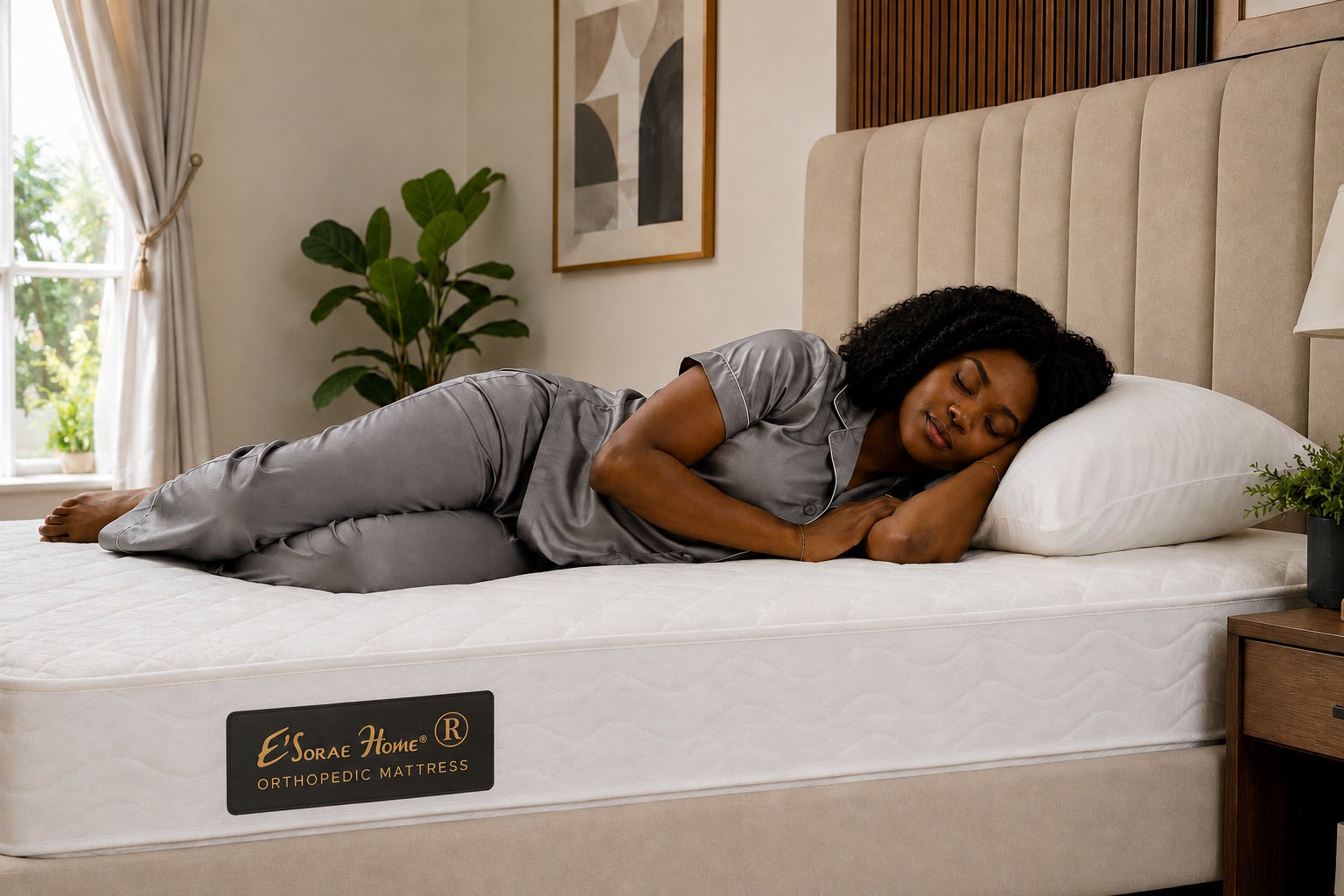
Choosing an orthopedic mattress should be simple. In practice, it rarely is.
Walk into any mattress showroom in Lagos and you’ll meet the same word printed on almost every label: orthopedic. Some of those mattresses genuinely support your spine. Many just feel hard.
That difference matters more than most shoppers realize. The right orthopedic mattress supports proper spinal alignment, spreads your body weight evenly, and lets your muscles switch off overnight. The wrong one creates pressure points and sends you back to the shop within two years.
This guide walks you through how to choose properly using body weight, sleeping position, materials, and Nigeria’s climate as your filters, not marketing language.
What an Orthopedic Mattress Actually Is
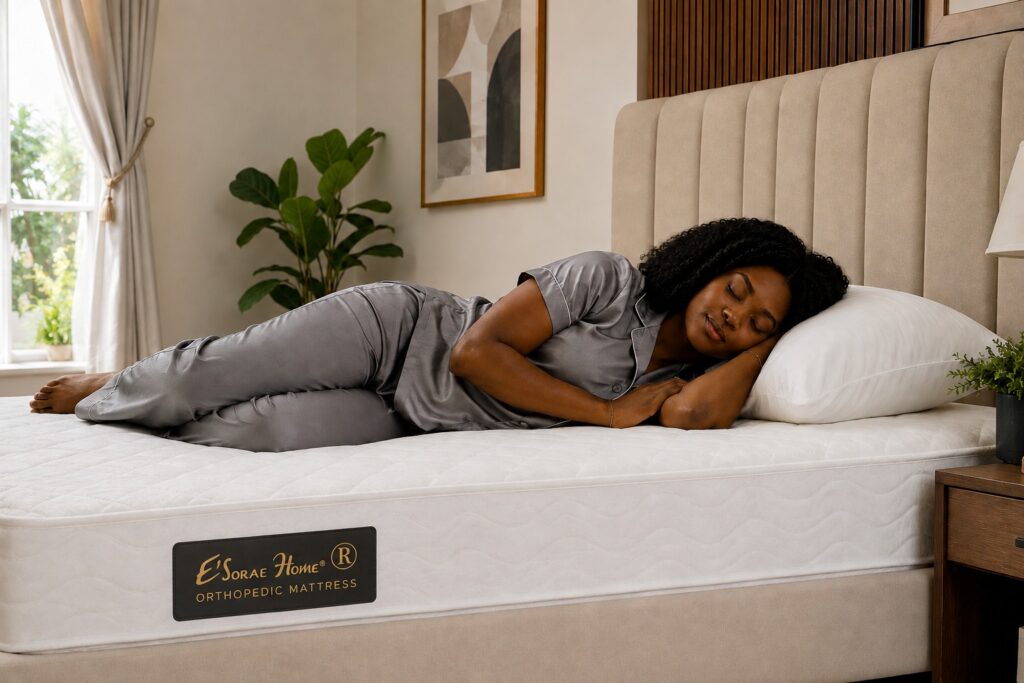
Quick definition: An orthopedic mattress is a mattress engineered to support the spine, joints and pressure points, using a reinforced support core that keeps the body in a neutral position throughout the night.
The category grew out of orthopedic medicine, which deals with the spine, bones and joints. Manufacturers began building mattresses with stiffer cores and zoned support so heavier areas — hips and shoulders wouldn’t sink out of line.
Here’s the part shops rarely explain. There is no global certification body that awards the word “orthopedic.” It describes a design approach, not a licence.
So the label alone tells you nothing. What tells you something is the construction: core density, support zoning, comfort layers, and edge reinforcement.
What it is not
- It is not automatically the hardest mattress on the floor
- It is not a medical device and cannot diagnose or cure a spinal condition
- It is not a replacement for physiotherapy or medical care
What a well-built one does
- Holds your lumbar curve in a neutral line
- Distributes body weight so no single joint carries the load
- Reduces the micro-movements that fragment deep sleep
- Keeps its shape for years instead of forming a body-shaped dip
Why Spinal Alignment Beats Firmness
Back pain is not a niche problem. According to the Global Burden of Disease study published in The Lancet Rheumatology, low back pain affected roughly 619 million people worldwide in 2020, and is projected to reach 843 million by 2050. The World Health Organization lists it as the single leading cause of disability globally.
That scale explains why “firm equals healthy” became such a stubborn belief. It also explains why researchers finally tested it.
What the research says
A landmark randomised, double-blind trial published in The Lancet in 2003 followed 313 adults with chronic non-specific low back pain for 90 days. Half slept on firm mattresses, half on medium-firm. The medium-firm group reported less pain in bed, less pain on rising, and less daytime disability.
A 2021 review in the Journal of Orthopaedics and Traumatology pooled 39 studies and reached the same conclusion: a medium-firm surface best supports sleep quality and spinal alignment for most adults.
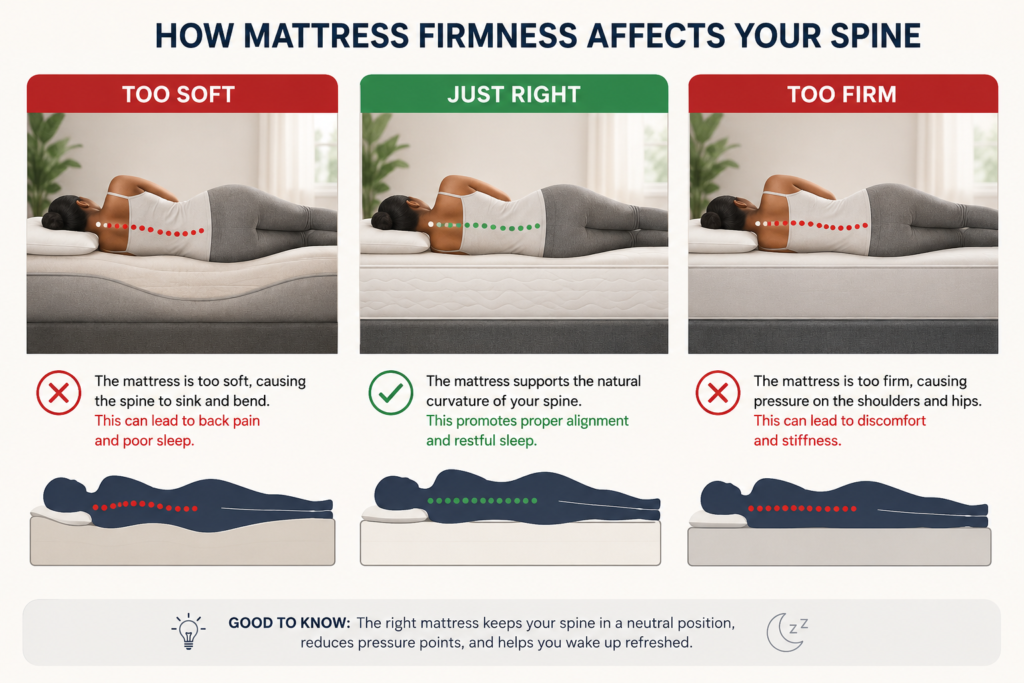
So the goal isn’t maximum hardness. The goal is a surface firm enough to stop your hips sinking, soft enough to let your shoulders settle in.
Think of it as a straight line, not a hard board. Lie on your side and your spine should run parallel to the mattress no dip at the waist, no arch at the hip.
Step 1: Match Firmness to Your Body and Sleep Position
This is where most buying decisions go wrong. Two people can lie on the same mattress and experience completely different support, because firmness is relative to body weight.
A 60kg sleeper barely compresses a firm foam core. A 100kg sleeper compresses the same core noticeably. Same mattress, different result.
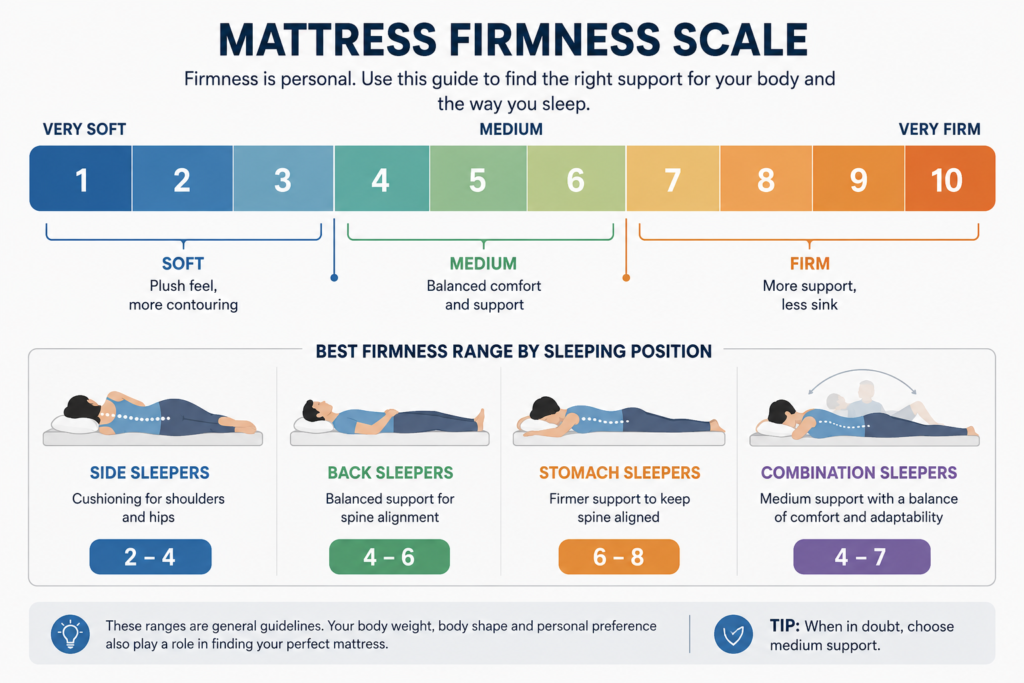
Use the chart below as your starting point.
Firmness guide by weight and sleeping position
| Sleeping position | Body weight | Suggested firmness (1–10) | Why it works |
|---|---|---|---|
| Side sleeper | Under 70kg | 4–5 (medium) | Shoulders and hips need room to sink or pressure builds |
| Side sleeper | 70–95kg | 5–6 (medium-firm) | Balances contouring with hip support |
| Side sleeper | Over 95kg | 6–7 (firm-leaning) | Prevents the hip dropping below spine line |
| Back sleeper | Under 70kg | 5–6 (medium-firm) | Fills the lumbar gap without lifting the pelvis |
| Back sleeper | 70–95kg | 6–7 (firm-leaning) | Holds the natural lower-back curve |
| Back sleeper | Over 95kg | 7–8 (firm) | Stops the midsection sagging |
| Stomach sleeper | Any weight | 7–8 (firm) | Keeps the pelvis from over-extending the lumbar spine |
| Combination sleeper | Any weight | 5–6 (medium-firm) | Responsive enough to change position easily |
Couples: solve for two bodies
Couples with a large weight difference should prioritise pocket-spring or zoned hybrid construction. Individually encased coils respond locally, so one person’s movement doesn’t travel across the bed.
Where preferences differ sharply, a shared medium-firm base plus one person adding a soft topper is usually more successful than compromising on the mattress itself.
Step 2: Understand What’s Inside the Mattress
Cover fabric sells mattresses. Core construction determines whether you sleep well in year four.
Orthopedic memory foam
High-density memory foam moulds to your contours and returns slowly. It excels at pressure relief around shoulders and hips.
Latex and latex hybrids
Natural latex is springier than memory foam and naturally more breathable thanks to its open-cell structure.
Pocket-spring orthopedic construction
Individually wrapped coils under a foam or latex comfort layer. This is the classic support-first build.
The four specs worth asking about
- Foam density: higher density resists permanent indentation
- Support zoning: reinforced sections under the lumbar region
- Edge support: usable sleeping area right to the perimeter
- Total height: under 20cm rarely delivers real orthopedic support for adults
Step 3: Factor In Nigeria’s Climate and Bed Sizes
International buying guides ignore two things that matter enormously here: heat and sizing conventions.
Heat and humidity
Lagos, Port Harcourt and Benin sit in humid coastal conditions for most of the year. A dense foam mattress that performs beautifully in a temperate climate can sleep uncomfortably warm in a Nigerian bedroom without air conditioning.
Look for gel-infused foam, latex layers, breathable knit covers, or spring cores that allow vertical airflow. If you already sleep hot, prioritise cooling construction over maximum contouring.
Humidity also encourages dust mites. A breathable, washable mattress protector is not optional it extends mattress life and protects the warranty.
Nigerian bed sizes
Mattresses here are sold in feet, and the conventions differ from UK or US labelling. Measure your frame before ordering.
| Common Nigerian size | Dimensions (feet) | Typically suits |
|---|---|---|
| Full XL | 4.5 × 6 | Single adult, guest room |
| Queen | 5 × 6 | Couples in compact rooms |
| King | 6 × 6 | Most Nigerian master bedrooms |
| UK King | 6 × 6.5 | Taller sleepers |
| California King | 6 × 7 | Tall sleepers, larger rooms |
| Super King | 7 × 7 | Couples wanting maximum space |
Delivery and access
Confirm stairwell and doorway clearance before delivery day. A 7 × 7 mattress that cannot turn a landing corner is an avoidable, expensive problem.
Step 4: Test It Properly Before You Pay
Two minutes perched on the edge of a showroom mattress tells you almost nothing. Test it the way you’ll actually use it.
- Lie down for at least ten minutes in your usual sleeping position, shoes off
- Slide a hand under your lower back. A large gap means too firm; heavy resistance means too soft
- Roll over twice. If changing position feels like work, the mattress is too soft or too slow
- Sit on the edge. Strong edges mean usable surface area and easier getting up
- Check the return terms in writing your body needs weeks, not minutes, to adapt
Esorae Home offers a 100-night comfort promise, which exists precisely because ten minutes in a showroom cannot replicate three weeks of real sleep.
Five Mistakes That Cost Buyers Money
Mistake 1: Assuming firmer is healthier. The clinical evidence points to medium-firm for most adults with back pain. Extra-firm suits stomach sleepers and heavier back sleepers specifically.
Mistake 2: Trusting the word “orthopedic” alone. Ask for density, coil count and warranty terms. Vague answers are informative.
Mistake 3: Buying purely on price. A cheap foam mattress replaced every two years costs more over a decade than one quality mattress that lasts eight.
Mistake 4: Keeping the old pillow. A great mattress with a collapsed pillow still leaves your cervical spine misaligned. Match your pillow to your sleeping position.
Mistake 5: Skipping the protector. Sweat and humidity degrade foam and void most warranties. A protector costs a fraction of a mattress.
Expert Tips From Our Sleep Consultants
Fifteen years of fitting mattresses across more than 60,000 Nigerian homes teaches you patterns. These are the ones that come up most.
Tip 1: Give any new mattress 21 to 30 nights. Your body adapts to a supportive surface; early stiffness is common and usually temporary.
Tip 2: Rotate head-to-toe every three to six months. This single habit is the difference between even wear and a permanent dip.
Tip 3: If you wake with pain that eases within thirty minutes of getting up, suspect your sleep surface. Pain that persists all day needs a doctor, not a mattress.
Tip 4: Air the mattress monthly. Open windows, pull back bedding for an hour, and let trapped moisture escape.
Tip 5: Buy the bed frame with the mattress where possible. A sagging or under-slatted base undermines even the best orthopedic mattress.
Orthopedic Mattress Comparison Chart
A practical comparison of support-focused options in the Esorae Home range.
| Model | Construction | Feel | Best suited to | Price range (₦) |
|---|---|---|---|---|
| Deluxe Orthopaedic Mattress | High-density orthopedic foam core | Firm | Back pain sufferers, back sleepers | 640,500 – 966,000 |
| Exclusive Orthopaedic Mattress | Premium zoned orthopedic build | Firm, premium | Buyers wanting maximum back support | 976,500 – 1,076,250 |
| Exclusive Semi-Orthopaedic Mattress | Latex and pocket spring hybrid | Medium-firm | Side and combination sleepers | 840,000 – 924,000 |
| Hybrid Latex Mattress | Natural latex over pocket springs | Medium-firm, cool | Hot sleepers wanting support | 619,500 – 966,000 |
| Memory Mattress | High-density memory foam | Medium-soft, plush | Shoulder and hip pressure relief | 577,500 – 918,750 |
| Exclusive Cool Max Mattress | Cooling-focused hybrid | Medium-firm, cool | Humid rooms, hot sleepers | 934,500 – 971,250 |
Prices are indicative and correct at the time of publishing. Confirm current pricing and available sizes on the product pages.
When to Replace Your Mattress
Most quality mattresses serve well for seven to ten years. Age alone isn’t the trigger, though performance is.
Replace yours when you notice:
- A visible dip or body impression that doesn’t recover
- Waking with stiffness that eases after you get up and move
- Sleeping noticeably better in hotels or guest beds
- Increased tossing, or waking your partner every time you move
- Sagging edges that reduce your usable sleeping area
If three or more apply, your mattress is now working against your sleep rather than supporting it.
Frequently Asked Questions
What is an orthopedic mattress?
An orthopedic mattress is designed to support the spine, joints and pressure points using a reinforced core and zoned support. It keeps the body in a neutral position to reduce strain on the lower back.
Is an orthopedic mattress good for back pain?
Yes, for many people. A 2003 randomised trial in The Lancet found medium-firm mattresses reduced pain and disability more effectively than firm ones in adults with chronic low back pain. Persistent pain should still be assessed by a doctor.
Should an orthopedic mattress be hard?
No. Supportive is not the same as hard. Most adults do best between 5 and 7 on a 10-point firmness scale, with heavier and stomach sleepers sitting higher.
Is memory foam or spring better for back support?
Memory foam excels at pressure relief and motion isolation. Pocket springs excel at airflow, edge support and zoned support. Hybrids combine both, which is why they suit most back-pain sufferers.
How much does an orthopedic mattress cost in Nigeria?
Genuine models from established brands typically start in the mid-six-figure Naira range and rise with size and construction. Very cheap “orthopedic” foam usually indicates low core density and a short lifespan.
Which orthopedic mattress is best for side sleepers?
Side sleepers generally need medium to medium-firm support with a contouring comfort layer. A semi-orthopedic or latex hybrid build cushions the shoulder while holding the hip in line.
How long does an orthopedic mattress last?
Seven to ten years with proper care. Rotating it regularly and using a protector meaningfully extends its life.
Can an orthopedic mattress be too firm?
Yes. An overly firm surface creates pressure at the shoulders and hips and can leave a gap under the lumbar curve, which increases discomfort rather than reducing it.
Do I need a new bed frame too?
If your current base sags, has widely spaced slats, or flexes under weight, yes. A weak frame transfers its own shape into the mattress.
How long before I feel the benefit?
Most people adapt within 21 to 30 nights. Sleep quality often improves first, with morning stiffness easing gradually after that.
Is an orthopedic mattress suitable for elderly sleepers?
Often, yes. Firm edge support makes getting in and out of bed safer, and consistent spinal support helps with arthritic and joint discomfort.
How do I keep it in good condition?
Rotate head-to-toe every three to six months, use a breathable protector, air it monthly, and never fold or bend a foam or hybrid mattress.
Final Thoughts
Choosing the right orthopedic mattress comes down to four honest answers: how much you weigh, how you sleep, how warm your room gets, and how long you want the mattress to last.
Get those right and firmness stops being a guess. You’re no longer shopping for the hardest surface available you’re shopping for proper spinal alignment, even body weight distribution, and genuine pressure relief.
That’s the whole point. A quality mattress isn’t a luxury purchase; it’s roughly a third of your life, spent well or spent badly.
Ready to find yours?
Explore the full Esorae Home mattress collection to compare orthopedic, semi-orthopedic, latex and cooling builds side by side. Every mattress ships with our 100-night comfort promise, so you can test it where it matters in your own bedroom.
Still unsure which firmness suits you? Take the 60-second sleep quiz or speak with a comfort expert we’ll match you to the right orthopedic mattress based on your weight, sleeping position and bedroom conditions.