


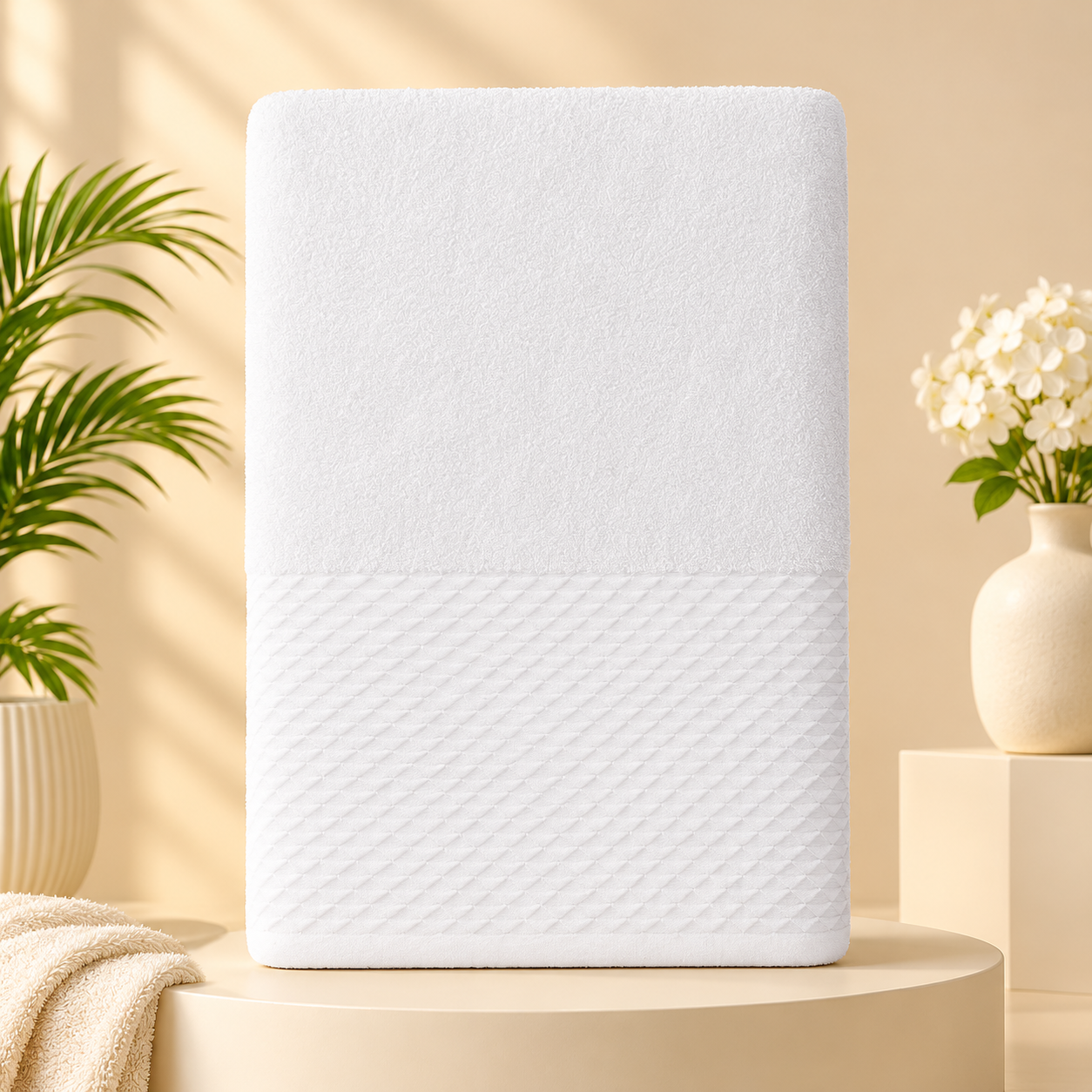
A good bath towel is made from long-fibre 100% cotton, weighs roughly 500 to 700 GSM, has a dense looped pile and measures at least 70 × 140 cm. Those four checks tell you more about a towel than its brand.
This guide explains each one in plain terms, shows you how to test a towel before you buy, and covers the washing habits that keep a bath towel soft and absorbent in Nigeria’s humid climate.
What makes a good bath towel?
A good bath towel feels soft on the skin, soaks up water quickly, dries between uses and keeps its shape after repeated washing. Four things control this: the cotton fibre, the fabric weight (GSM), how the loops are woven, and the finishing. A towel that fails on any one of them tends to go flat, rough or musty long before it should.
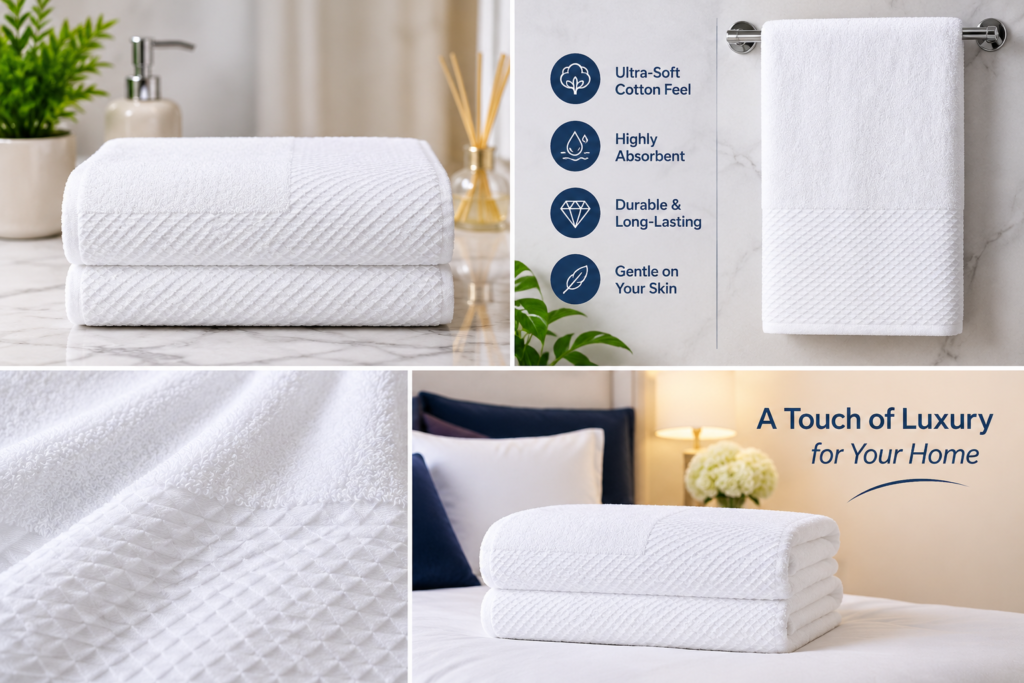
How do you choose a bath towel?
Choose a bath towel by checking six things in order: fibre, weight, pile, size, finishing and how you will use it. Fibre and weight decide how soft and absorbent it is. Size and finishing decide how comfortable and durable it is day to day.
- Fibre. Pick 100% cotton. Polyester dries fast but is not absorbent or soft, so it suits gyms and kitchens more than bathrooms.
- Weight (GSM). Match the GSM to how you use the towel (table below).
- Pile. Press the towel between your fingers. It should feel dense and springy, not thin or flat.
- Size. A 70 × 140 cm bath towel suits most adults. Taller people or anyone who likes full wrap-around coverage should consider a bath sheet.
- Finishing. Look for neat, double-stitched hems and even loops. A certification such as STANDARD 100 by OEKO-TEX, which tests textiles for harmful substances, is a useful trust signal.
- Use. Everyday family towel, guest towel, gym bag or gift set? The answer changes the best weight and size.
What does GSM mean on a bath towel?
GSM stands for grams per square metre. It measures how heavy the towel fabric is: the higher the number, the more cotton in each square metre, so the towel is usually thicker, plusher and more absorbent.
Towel retailers commonly group weights like this (Towel Super Center):
| GSM range | Feel | Best for |
|---|---|---|
| 300 to 400 | Light, dries fastest | Gym bag, travel, quick showers |
| 400 to 620 | Mid-weight, balanced | Everyday bath towels, guest towels |
| 620 to 900 | Heavy, thick, plush | Luxury, spa-style comfort |
The same guide suggests bath towels of 500 GSM or more. Our recommendation for everyday use in Nigeria is 500 to 700 GSM: thick enough to feel premium, but not so heavy that it stays damp for hours in humid weather.
GSM is not a quality score on its own. A heavy towel made from short, coarse fibres can still feel rough, so read GSM together with the cotton type.
Which cotton is best for bath towels: Egyptian, Turkish or regular?
Egyptian and Turkish cotton are both long-fibre cottons and generally make softer, stronger, more absorbent towels than regular short-fibre cotton. Egyptian cotton is usually the most absorbent. Turkish cotton is very durable and a little less absorbent.
| Cotton type | Fibre | What it means for you |
|---|---|---|
| Egyptian cotton | Finer, longer and more porous than regular cotton | Dense, strong, highly absorbent towels |
| Turkish cotton | Extra-long fibres | Durable, premium feel, slightly less absorbent than Egyptian |
| Regular cotton | Shorter fibres | Lower cost, but can feel rougher and wear faster |
Fibre descriptions follow Towel Super Center. Be careful with labels such as “Egyptian-style” or “premium cotton”, which do not tell you the fibre. Ask the seller what the towel is made of, and prefer product pages that state the fibre and GSM clearly.
How do you tell if a bath towel is soft and absorbent before buying?
Press it, scratch it and check the label. A soft, absorbent towel feels dense and cushiony when squeezed, has even loops with no bald patches, and states its fibre and GSM. In a shop, a quick test is to rub the pile with a dry hand and look for loose lint.
Softness and absorbency are not the same thing. Some towels are treated with silky finishes that feel luxurious on the shelf but can repel water until they are washed a few times. If a new towel feels slick rather than cushiony, wash it before judging it.
Buying online? You cannot touch the towel, so rely on the product page: 100% cotton, a stated GSM, a stated size and clear photos of the weave.
Thick or quick-drying: which bath towel should you choose?
The best choice depends on your bathroom and routine. Thick, heavy towels feel plush and hold the most water but take longer to dry. Mid-weight towels balance absorbency with faster drying, which matters in humid cities like Lagos or during the rainy season when towels dry indoors.
A practical way to decide:
- One towel per person, hung to dry daily: mid-weight, 500 to 600 GSM.
- Spa feel, towel dried in a well-aired bathroom: heavier, 600 GSM and above.
- Gym, travel or beach: lighter, 300 to 400 GSM.
What size bath towel do you need?
A standard bath towel is about 70 × 140 cm and a bath sheet is about 100 × 160 cm. Choose a bath sheet if you want full wrap-around coverage or you are tall.
| Item | Typical size | Use |
|---|---|---|
| Face cloth | 30 × 30 cm | Face and hands |
| Hand towel | 50 × 100 cm | Basin, guest bathroom |
| Bath towel | 70 × 140 cm | Everyday drying |
| Bath sheet | 100 × 160 cm | Large, wrap-around drying |
Sizes vary by maker, so check the listing. Typical dimensions are from Soak & Sleep’s size guide.
What is the difference between a bath towel and a bath sheet?
A bath sheet is a larger bath towel, roughly 100 × 160 cm against 70 × 140 cm. It wraps fully around the body and absorbs more per use, but it is heavier when wet and needs more space to dry. Many households keep bath towels for daily use and bath sheets for after a long shower.
What are the most common mistakes when buying bath towels?
The most common mistakes are buying on GSM alone, ignoring the cotton type, choosing a size that is too small, and judging softness before the first wash. Most of these are easy to avoid once you know what to look for.
- Chasing the highest GSM. Heavier is not always better. It dries slower and may not suit daily use.
- Ignoring fibre. Two towels with the same GSM can feel very different if one uses longer cotton.
- Buying one pack and nothing else. You need a rotation, so towels can dry fully between uses.
- Washing coloured towels with whites the first time, which can transfer dye.
- Trusting vague claims. “Luxury” and “premium” mean little without fibre, GSM and size.
How do you wash bath towels so they stay soft and absorbent?
Wash bath towels every three to four days, use the recommended amount of detergent, skip fabric softener, and dry them fully before storing. Detergent build-up and softener residue are the two main reasons towels turn scratchy and stop absorbing (Towel Super Center care guide).
- Wash on schedule. Every three to four days for personal use.
- Measure detergent. Extra detergent can stop the rinse from fully removing soap.
- Avoid fabric softener. It leaves a residue that makes towels scratchy and less absorbent.
- Do not overload the machine. Crowded towels do not rinse clean.
- Shake before drying. This lifts the loops and helps towels dry evenly.
- Dry fully. Putting towels away damp encourages bacteria and odour.
How do you stop bath towels smelling musty?
Musty towels usually mean they were stored damp or washed with too much detergent. Rewash with one cup of white vinegar instead of detergent, follow with a cup of baking soda, then dry completely. Hang towels fully open between uses so air reaches every fold.
If you line-dry in the sun, shake each towel well before folding. Sun-dried towels can feel stiffer, and a good shake or a few minutes in the dryer on low heat brings the loops back.
How long do bath towels last?
There is no fixed lifespan. Well-made cotton towels that are washed correctly and dried fully can stay in use for years, while thin, low-quality towels can go rough or flat much sooner. Replace a towel when it stays scratchy after a proper wash, no longer absorbs, frays at the hems or keeps a persistent odour.
What affects the price of a bath towel?
Price mainly reflects fibre quality, GSM, size and finishing. Long-fibre cotton and heavier weights cost more to make, and so do larger bath sheets and certified fabrics. A cheaper towel that needs replacing quickly can cost more over time than a better one that lasts, so compare cost per year of use, not just the price today.
Which bath towel is right for you?
| If you want | Look for | Consider |
|---|---|---|
| A reliable everyday towel | 100% cotton, 500 to 650 GSM, 70 × 140 cm | Bath towels |
| Full wrap-around comfort | Larger size, plush pile | Bath sheets |
| A matched set for your home or as a gift | Consistent colour and weight across pieces | Luxury Towel Set |
Esorae Home is a Lagos-based luxury home goods brand, and check each product page for the fabric, GSM and size so you can compare it against the checklist above. Browse the bath towel collection for everyday towels, the bath sheet range for extra-large wraps, or the Luxury Towel Set for a complete, coordinated set.
Final thoughts: choosing a bath towel that lasts
The best bath towel is the one that matches how you live: long-fibre 100% cotton, a weight that suits your bathroom, a size that wraps you comfortably, and care that protects the loops. Check fibre, GSM, pile and finishing before you buy, skip fabric softener, and let every towel dry fully. Do that, and your bath towels stay soft and absorbent far longer.
4. FAQ section
What GSM is best for bath towels?
For everyday use, 500 to 700 GSM is a good range: thick and absorbent without staying damp for too long. Lighter towels of 300 to 400 GSM dry fastest and suit the gym or travel, while 620 GSM and above gives a heavy, spa-style feel. Check the cotton type as well, since GSM alone does not show softness.
Which is better for bath towels, Egyptian or Turkish cotton?
Both are long-fibre cottons and make premium towels. Egyptian cotton is usually the more absorbent, with finer, longer and more porous fibres. Turkish cotton is very durable and slightly less absorbent. Either beats regular short-fibre cotton for softness and wear.
How often should you wash bath towels?
Wash bath towels every three to four days if only you use them. Hang them fully open between uses so they dry completely, and wash sooner if a towel smells musty or has stayed damp. Avoid fabric softener, which can leave a residue that makes towels less absorbent.
Why do my bath towels stop absorbing water?
Usually because of residue. Fabric softener and too much detergent coat the fibres and block water. Rewash with a cup of white vinegar and no detergent, then a cup of baking soda, and dry fully. Overloading the washing machine can also leave soap in the towels.
How long do bath towels last?
There is no fixed lifespan. Good cotton towels that are washed correctly and dried fully can last for years, while thin, low-quality ones wear out much sooner. Replace a towel when it stays scratchy after washing, stops absorbing, frays or keeps a lasting odour.
What is the difference between a bath towel and a bath sheet?
A bath sheet is larger: about 100 × 160 cm compared with about 70 × 140 cm for a bath towel. It wraps fully around the body and absorbs more per use, but it is heavier when wet and takes longer to dry. Sizes vary by maker, so check the listing.
Are thicker bath towels always better?
No. Thicker, heavier towels feel plush and hold more water but dry slower, which can be a drawback in humid weather. A mid-weight towel of 500 to 650 GSM in long-fibre cotton is often the best balance for daily use. Choose heavier only if you want a luxury feel and have space to air-dry it.
How can I tell if a bath towel is good quality when buying online?
Read the product page for the fibre (100% cotton, and which type), the GSM, the size and the stitching details, and look at close-up photos of the weave. Vague words like “premium” or “luxury” with no specifications are a warning sign. A certification such as STANDARD 100 by OEKO-TEX is a helpful extra.