


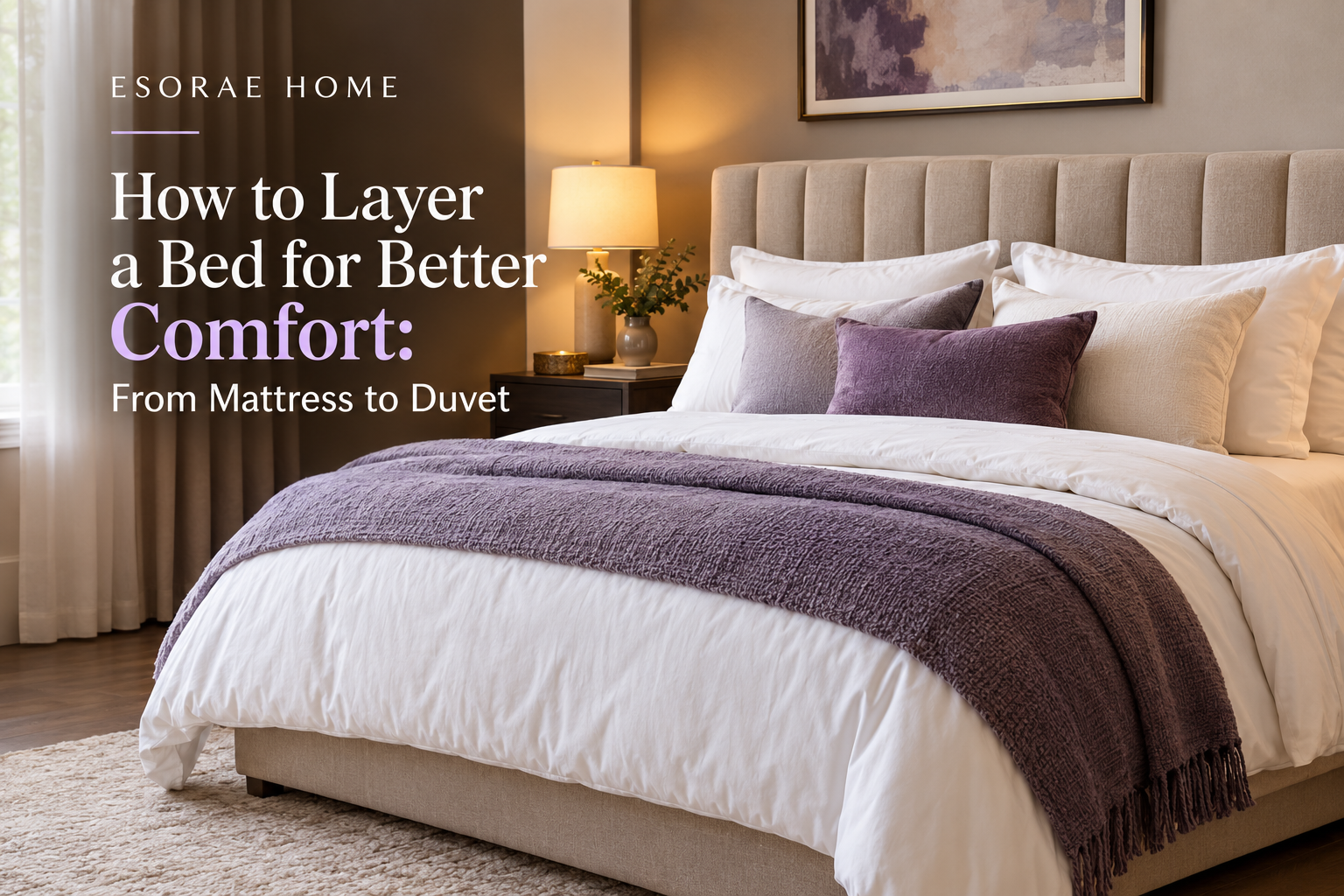
A well-layered bed is easy to get right once you know the order. Each layer has one job (cushion, protect, smooth, warm or finish), and stacking them in the wrong sequence is why beds look lumpy, sheets slip and toppers wear out early.
This guide shows how to layer a bed from the mattress up, how a topper and protector fit together, and how to adjust the setup for Nigerian weather.
How Do You Layer a Bed?
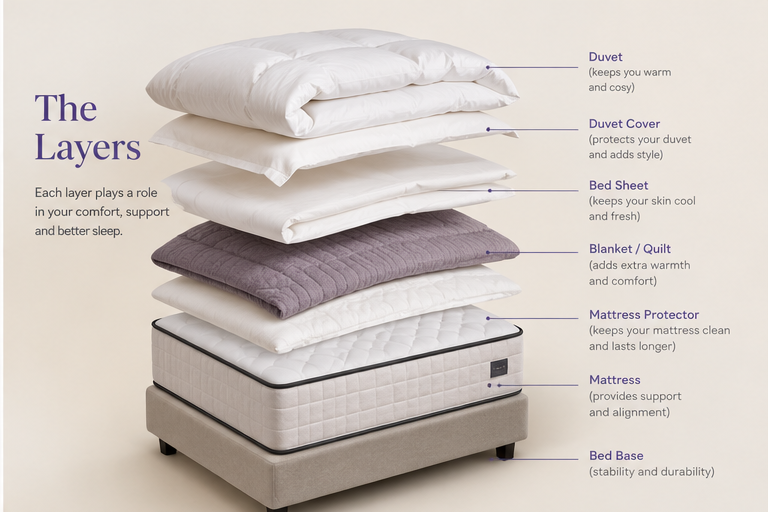
How To layer a bed ? To layer a bed, build from the mattress upward: mattress topper, mattress protector, fitted sheet, flat sheet, duvet (in a cover), then pillows and an optional throw at the foot. Each layer protects, cushions or warms in a specific order, so the sheets stay clean and the duvet stays neat.
The Bed Layering Order at a Glance
| Order | Layer | What it does |
|---|---|---|
| 1 | Mattress | Main support |
| 2 | Mattress topper | Adds cushioning, adjusts firmness |
| 3 | Mattress protector | Shields mattress and topper from sweat, spills and dust |
| 4 | Fitted sheet | The surface you sleep on |
| 5 | Flat sheet | Keeps the duvet clean; adds an easy-to-adjust layer |
| 6 | Duvet with cover | Main warmth layer |
| 7 | Pillows and throw | Comfort and finish |
Not every bed needs all seven layers. The essentials are the mattress, fitted sheet and something to sleep under. A topper, protector and flat sheet are upgrades that add comfort, hygiene and a longer life for what sits beneath them.
Step-by-Step: How to Layer Your Bed
Step 1: Lay the Mattress Topper (If You Use One)
A mattress topper is a removable cushioning layer that sits directly on the mattress. Unroll it, centre it, and align its corners with the mattress corners. If it is new and compressed, give it time to expand: Esorae’s Memory Mattress Topper page recommends unrolling it and letting it expand for 24 to 48 hours.
A topper with a non-slip base stays put without straps. If yours slides, add a non-slip pad between the mattress and topper.
Step 2: Add the Mattress Protector
Pull the protector over the mattress and topper together, like a large fitted sheet, tucking each corner underneath. Because its job is to shield both the mattress and the topper, it should sit closest to your sheet.
A protector adds almost no comfort. Its value is that stains, sweat and dust hit a washable layer instead of a mattress you cannot launder.
Step 3: Fit the Sheet Tightly
Put the fitted sheet on one corner at a time, starting with the hardest corner, and check the seams sit at the top edge of the mattress. A wrinkle-free fitted sheet is the biggest single factor in whether a bed looks made.
If you use a topper, check the sheet’s pocket depth (see the sizing section below). A sheet that is too shallow will pop off the corners overnight.
Step 4: Add the Flat Sheet
Lay the flat sheet pattern-side down with its wide hem at the head of the bed, so the folded-back edge shows the right side. Tuck it in at the foot and sides. Leave the top edge free so it can fold over the duvet.
A flat sheet is optional but useful. It sits between you and the duvet, so the duvet cover stays clean longer, and in warm weather you can sleep under just the sheet.
Step 5: Add the Duvet
A duvet is a soft, filled cover for the bed. Most are used inside a removable duvet cover, which is what you wash. Fit the insert into its cover, shake it flat, then lay it over the flat sheet. Fold the top edge of the flat sheet back over the duvet, then fold the duvet itself back about a third of the way for a layered look.
Step 6: Finish with Pillows and a Throw
Place your sleeping pillows against the headboard, with decorative pillows or Euro shams in front if you like them. Fold a blanket or throw across the foot of the bed. The throw is optional, but it is the easiest layer to add or remove on a cooler night.
How to Layer a Bed with a Mattress Topper
To layer a bed with a mattress topper, place the topper directly on the mattress, add a mattress protector over both, then a fitted sheet large enough to cover the combined height. The topper always goes under the sheets, never on top of them.
How To layer a bed: Does a Fitted Sheet Go Over a Mattress Topper?
Yes. A fitted sheet goes over the topper (and over the protector on top of it). The sheet must be deep enough to cover the mattress and topper together.
How to check your fitted sheet size: Add the mattress height to the topper thickness, then choose a sheet whose pocket depth is at least that measure. For example, a 12-inch mattress with a 2.5-inch topper, which is the thickness of Esorae’s Memory Mattress Topper, needs a fitted sheet with a pocket of at least 14.5 inches. Leave a little spare so the corners do not spring off.
How To layer a bed: Common Topper Layering Mistakes
- Putting the topper over the fitted sheet, where it slides and cannot be washed with the bedding.
- Using a fitted sheet sized only for the mattress.
- Skipping the protector, which leaves the topper exposed to sweat and spills.
- Choosing a topper smaller than the mattress, which leaves an uneven edge.
Mattress Protector vs Topper: What Is the Difference?
How To layer a bed: A mattress protector guards your mattress against sweat, spills and dust; it adds almost no comfort. A mattress topper adds cushioning and changes how the bed feels. They do different jobs, and many beds benefit from both, with the protector going over the topper.
| Mattress protector | Mattress topper | |
|---|---|---|
| Main purpose | Protection | Comfort and feel |
| Thickness | Thin, like a fitted sheet | Usually a few inches |
| Changes bed firmness? | No | Yes |
| Position in the stack | Over mattress and topper, under fitted sheet | Directly on the mattress |
| Washable? | Yes, typically | Depends; check for a removable cover |
| Best for | Any bed | Beds that feel too firm, worn or uneven |
The best option depends on your problem. If the mattress is comfortable and you want to keep it clean, choose a protector. If it feels too firm or is starting to wear, a topper can add comfort without the cost of a new mattress, but it does not repair a mattress that has structurally failed.
How to Layer a Bed for Nigerian Weather
The classic layering order stays the same in Nigeria. What changes is how much warmth you put on top. The lower layers (topper, protector, fitted sheet) stay year-round; the upper layers are the ones you swap.
| Situation | What to adjust |
|---|---|
| AC on at night | Keep the duvet, but choose a lighter one so you are not fighting the AC. Use the flat sheet so you can push the duvet down easily. |
| Hot, humid nights without AC | Drop the duvet. Sleep under the flat sheet or a light throw. Choose breathable fabrics. |
| Harmattan (roughly December to February) | Cooler nights and dry air: add the duvet or a blanket at the foot of the bed. |
| Rainy season | Air the bed each morning and make sure washed layers are completely dry before they go back on. |
This is practical guidance rather than a rule; the right combination depends on your bedroom, AC settings and personal comfort.
How to Layer a Bed Look Hotel Style
How To layer a bed: Hotel-style beds look crisp because of three things: a smooth fitted sheet, a flat sheet folded over a white or neutral duvet, and a consistent pillow arrangement. In practice, that is a matter of restraint, not extra layers.
- Stick to a neutral base. White or one-tone sheets, with colour coming from a throw or cushions.
- Smooth every layer. Wrinkles under the duvet still show through.
- Fold the flat sheet over the duvet. This creates the clean band at the top.
- Use matching pillowcases. Two or four sleeping pillows arranged evenly.
- Keep decoration minimal. One throw, a few cushions, nothing else.
What You Need to know on how layer a Bed: A Simple Checklist
- Mattress topper: If your mattress feels too firm or worn. Esorae’s Memory Mattress Topper is 2.5 inches thick, comes in Full XL, Queen, King, California King and Super King sizes, and includes a removable, machine-washable cover and a non-slip bottom.
- Mattress protector: For every bed, ideally over the topper.
- Fitted sheet and flat sheet: Esorae’s Sheet Sets include the Sovereign Line Bedsheets in colours from Crystal White to Navy Blue.
- Duvet and duvet cover: Match the size to your bed.
- Pillows and pillowcases: Plus a throw for the foot of the bed.
Conclusion
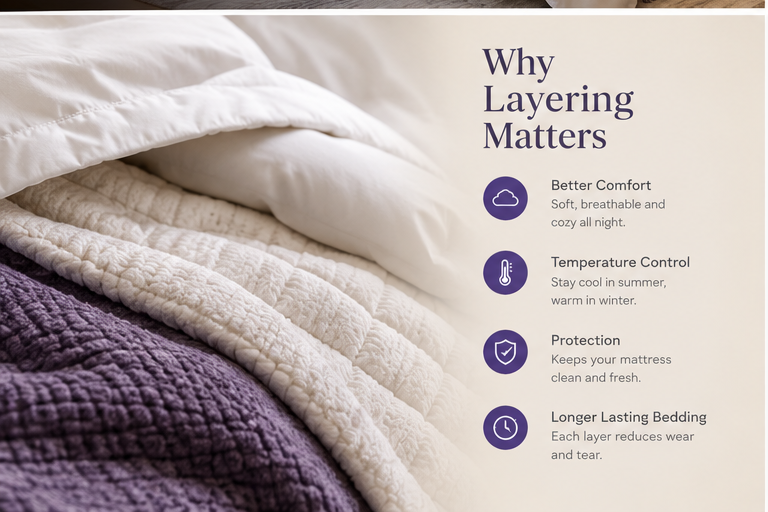
Knowing how to layer a bed comes down to one order: mattress, topper, protector, fitted sheet, flat sheet, duvet, pillows. Get the base layers right, adjust the top layers for the weather, and the bed will look neater, feel better and last longer.
If you are missing a layer, start at the bottom. A topper and fitted sheet change how the bed feels every night, and the rest can be built up over time.
FAQ Section
1. What order do you layer a bed?
Layer a bed from the bottom up: mattress, topper, mattress protector, fitted sheet, flat sheet, duvet in a cover, then pillows and a throw. You can skip the topper or flat sheet, but the order of the remaining layers stays the same.
2. Does a mattress topper go under the fitted sheet?
Yes. The topper sits directly on the mattress, and the fitted sheet goes over it. The sheet must be deep enough to cover the mattress and topper combined, or the corners will pull off.
3. Does the mattress protector go over or under the topper?
Over. A protector pulled over both mattress and topper shields both from sweat and spills, and it sits closest to your sheet. Check your topper’s care instructions if it has a special cover.
4. Do you need a flat sheet if you use a duvet?
Not strictly, but it helps. A flat sheet keeps body oils off the duvet cover, so the cover needs washing less often, and it gives you a lighter layer for warm nights. If you skip it, wash the duvet cover weekly.
5. What size fitted sheet do I need with a mattress topper?
Add the mattress height to the topper thickness and pick a sheet with at least that pocket depth. A 12-inch mattress plus a 2.5-inch topper needs a pocket of about 14.5 inches, with a little spare for a secure fit.
6. How often should you wash bedding layers?
The Sleep Foundation advises washing sheets weekly. As a rule, the nearer a layer is to your skin, the more often it needs washing: pillowcases and sheets weekly, duvet covers every few weeks, protectors every one to two months, and duvets every few months.
7. How do you layer a bed for hot weather?
Keep the topper, protector and fitted sheet, and remove the heavy top layers. Sleep under a flat sheet or light throw instead of a duvet. If you use AC, a lighter duvet with a flat sheet underneath is easy to adjust through the night.